

Training Football: A Complete Guide for Coaches and Teams
Modern football demands more from players than ever before. Match analysis reveals that elite athletes cover 10-13 kilometers per game, perform hundreds of accelerations and decelerations, and execute technical skills under physical and mental pressure. For coaches working with athletes at any level-from youth academies to adult leagues-designing effective training sessions is both an art and a science. The challenge lies in balancing physical preparation, technical skill development, tactical understanding, and player wellbeing within limited practice time. With the right approach to training football, coaches can maximize player development while minimizing injury risk and burnout.
Essential Components of Modern Training Football Sessions
Every effective training football session builds on four interconnected pillars: physical preparation, technical execution, tactical awareness, and mental resilience. These components should not exist in isolation but instead integrate seamlessly throughout practice.
Physical preparation encompasses strength, speed, agility, endurance, and injury prevention. Research shows that evidence-based warm-up protocols significantly reduce injury rates when implemented consistently. A comprehensive warm-up should include dynamic stretching, neuromuscular activation, and sport-specific movements that prepare players for the demands ahead.
Structuring the Session Framework
The most successful coaches follow a consistent framework that players recognize and respond to effectively. The FA's training strategy emphasizes a Plan-Do-Review approach that creates clear learning objectives.
Key structural elements include:
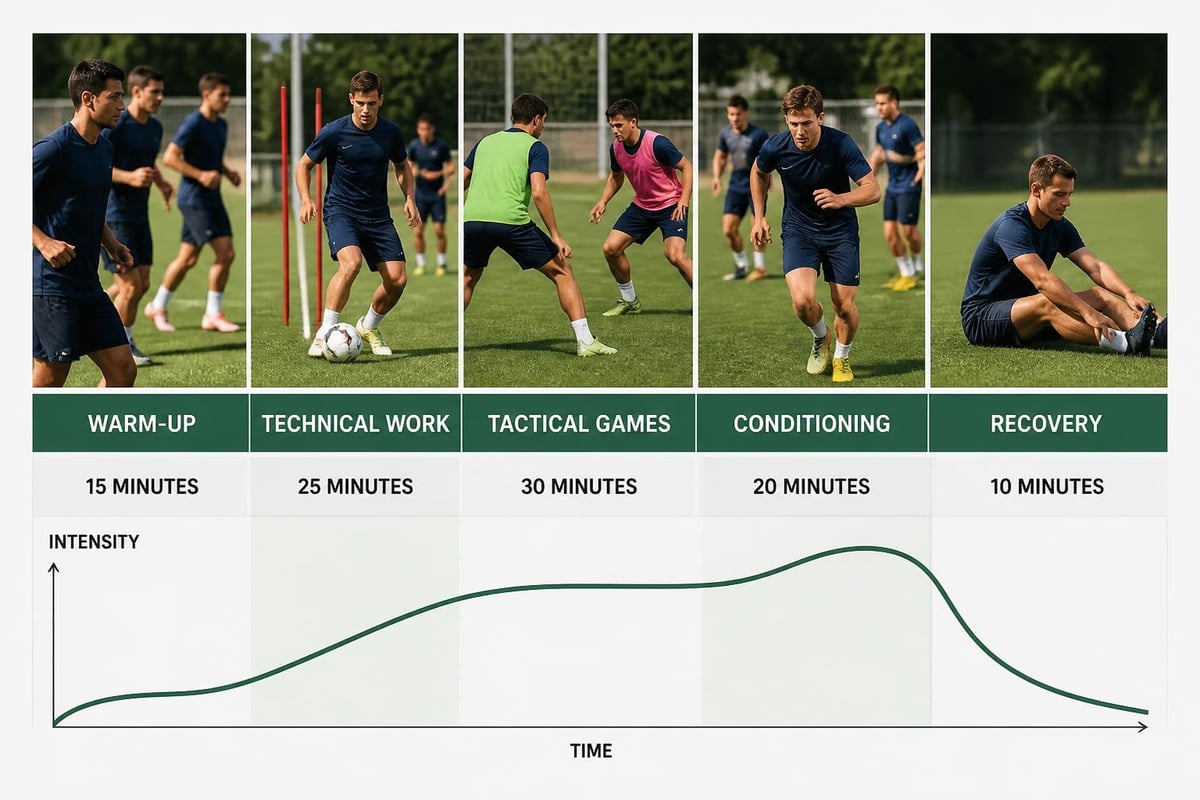
- Warm-up and activation (10-15 minutes)
- Technical skill work (15-20 minutes)
- Tactical exercises or small-sided games (25-35 minutes)
- Conditioning or position-specific work (15-20 minutes)
- Cool-down and recovery (5-10 minutes)
This structure allows for progression from individual skills to collective team concepts while managing physical load appropriately. Training football sessions should build intensity gradually, peak during the tactical phase, and taper during cool-down.
Position-Specific Training Demands
Not all players face identical physical demands during matches. Research on positional differences demonstrates that central midfielders cover the most total distance, while wide attackers and fullbacks perform the highest number of high-speed runs and sprints.
| Position Category | Total Distance | High-Speed Running | Sprint Frequency | Technical Actions |
|---|---|---|---|---|
| Central Defenders | 9-10 km | Low | Low | Moderate |
| Fullbacks | 10-12 km | High | Very High | High |
| Central Midfielders | 11-13 km | Moderate | Moderate | Very High |
| Wide Attackers | 10-11 km | Very High | Very High | High |
| Strikers | 9-10 km | High | High | Moderate |
This data should inform how coaches design training football drills and manage individual player loads. Position-specific circuits can supplement team sessions, allowing players to train movements and energy systems specific to their match demands.
Periodization and Load Management Strategies
Intelligent planning separates good programs from great ones. Periodization-the systematic planning of training variables over time-helps coaches optimize performance while managing fatigue and injury risk.
Weekly Microcycle Design
Most professional teams operate on a seven-day microcycle between matches. UEFA coaching frameworks recommend varying training load throughout the week based on match proximity and recovery status.
A typical weekly structure includes a recovery day after matches (low intensity, regenerative work), followed by a gradual build to peak physical load at mid-week (2-3 days post-match), then tapering as the next match approaches. Training football intensity should mirror this pattern, with high-load technical and tactical work scheduled when players are adequately recovered.
Sample weekly load distribution:
- Match Day +1: Active recovery, pool work, stretching
- Match Day +2: Moderate intensity technical work, tactical review
- Match Day +3: High-intensity tactical training, physical peak
- Match Day +4: Moderate intensity, position-specific work
- Match Day +5: Lower volume, set pieces, match preparation
- Match Day -1: Activation session, tactical walk-through
- Match Day: Competition
Monitoring Training Load and Recovery
Modern tracking systems provide valuable data on external load (distance, speed, accelerations) and internal load (heart rate, perceived exertion). However, these tools are most effective when coaches understand how to interpret and apply the information.
Simple monitoring methods include session rating of perceived exertion (sRPE), wellness questionnaires, and visual observation of movement quality. Studies linking physical demands with player wellbeing demonstrate that consistent monitoring helps prevent overtraining and identifies players at elevated injury risk.
Teams with access to quality training equipment can standardize drills and establish baseline metrics for comparison over time. GPS units, heart rate monitors, and timing gates provide objective data, but subjective coach observation remains equally valuable.
Technical Skill Development and Drill Design
Technical mastery forms the foundation of player development. Training football drills should challenge players at an appropriate level while maintaining high repetition of game-realistic movements.
Progressive Skill Acquisition Model
Effective technical training follows a progression from unopposed to opposed, from predictable to unpredictable, and from slow to match speed. This allows players to build confidence and competence before adding pressure.
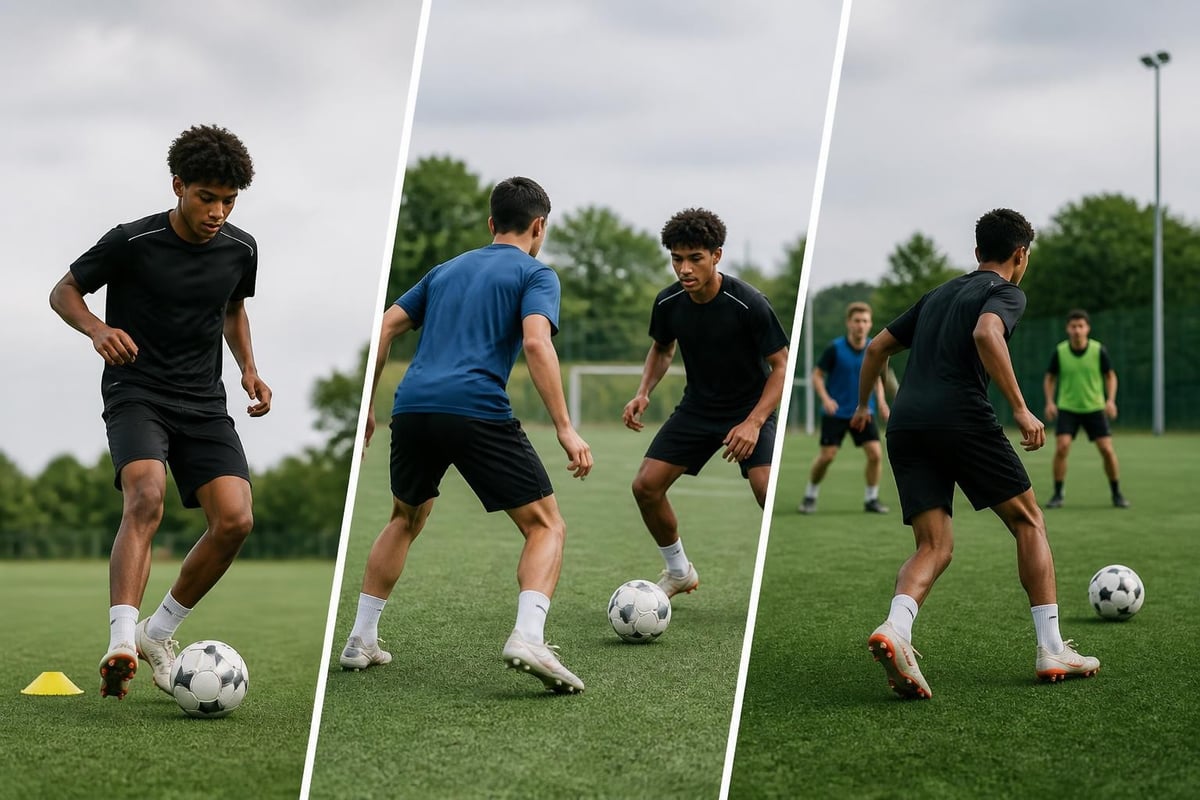
Four-stage technical progression:
- Isolation: Individual work on specific technique (e.g., passing against a wall, cone dribbling)
- Repetition: Partner or small-group work with predictable patterns
- Variability: Introduction of decision-making and multiple options
- Competition: Game-realistic pressure with opponents and consequences
When training football fundamentals, coaches should emphasize quality over quantity initially, then gradually increase speed and pressure as technique solidifies. Portable training equipment allows coaches to set up multiple stations and maximize active training time for all players.
Small-Sided Games for Technical and Tactical Development
Small-sided games (SSGs) represent one of the most efficient training football methods available. These modified games increase individual ball touches, decision-making opportunities, and physical load compared to full 11v11 formats.
Research consistently shows that SSGs improve aerobic capacity, repeated sprint ability, and technical execution simultaneously. The key variables coaches can manipulate include field dimensions, player numbers, rules, and objectives.
| Game Format | Primary Benefits | Physical Intensity | Technical Touches |
|---|---|---|---|
| 3v3 (small area) | 1v1 skills, high intensity | Very High | Very High |
| 5v5 (medium area) | Passing, support angles | High | High |
| 7v7 (larger area) | Tactical spacing, transitions | Moderate-High | Moderate |
| 9v9 (full pitch width) | Positional play, game realism | Moderate | Moderate |
Coaches should select SSG formats based on session objectives. If the goal is improving passing under pressure, a 5v5 possession game achieves better results than 9v9. For tactical shape work, larger formats provide more realistic spacing and decision-making contexts.
Physical Conditioning and Athletic Development
Physical preparation enables technical skill expression during matches. Training football sessions must systematically develop the energy systems, movement patterns, and physical qualities players need to compete effectively.
Developing Football-Specific Endurance
Football requires a unique blend of aerobic and anaerobic capacity. Players must sustain moderate-intensity running for 90+ minutes while repeatedly performing high-intensity actions (sprints, jumps, changes of direction).
Understanding high-speed running thresholds helps coaches prescribe appropriate conditioning doses. Most systems define high-speed running as exceeding 5.5 m/s and sprinting as exceeding 7.0 m/s, though exact thresholds vary by individual player capacity.
Interval training formats commonly used in training football include:
- High-intensity intervals: 15-30 seconds at 90-95% max heart rate, 1-3 minute recovery
- Repeated sprint training: 3-7 sprints of 20-40 meters, 20-30 second recovery between reps
- Aerobic power intervals: 2-4 minute efforts at 85-90% max heart rate, equal or slightly longer recovery
- Tempo runs: 8-15 minute continuous runs at 70-80% max heart rate
These can be integrated into training football drills using ball work, small-sided games, or position-specific patterns rather than generic running. This approach maintains engagement and develops conditioning in game-realistic contexts.
Strength and Power Development
NSCA professional standards provide comprehensive guidance on resistance training program design for team sport athletes. Football players benefit from multi-planar strength, explosive power, and deceleration capacity.
Essential strength and power exercises include:
- Lower body: squats, deadlifts, lunges, single-leg variations
- Upper body: presses, pulls, rows, core anti-rotation work
- Power: Olympic lift variations, medicine ball throws, plyometrics
- Movement: acceleration mechanics, deceleration drills, change of direction patterns
Strength training typically occurs 2-3 times weekly during pre-season and 1-2 times weekly in-season. Programs should complement rather than compete with on-field training football loads. Teams with access to appropriate fitness equipment can implement structured programs that develop physical qualities without excessive time commitment.
Tactical Training and Game Model Implementation
Technical skill and physical capacity only translate to success when players understand when, where, and how to apply them. Tactical training develops this decision-making capability within a team's playing philosophy.
Building a Coherent Game Model
UEFA coaching convention documents emphasize that successful teams operate from a clear game model-a shared understanding of how the team wants to play in all game phases.
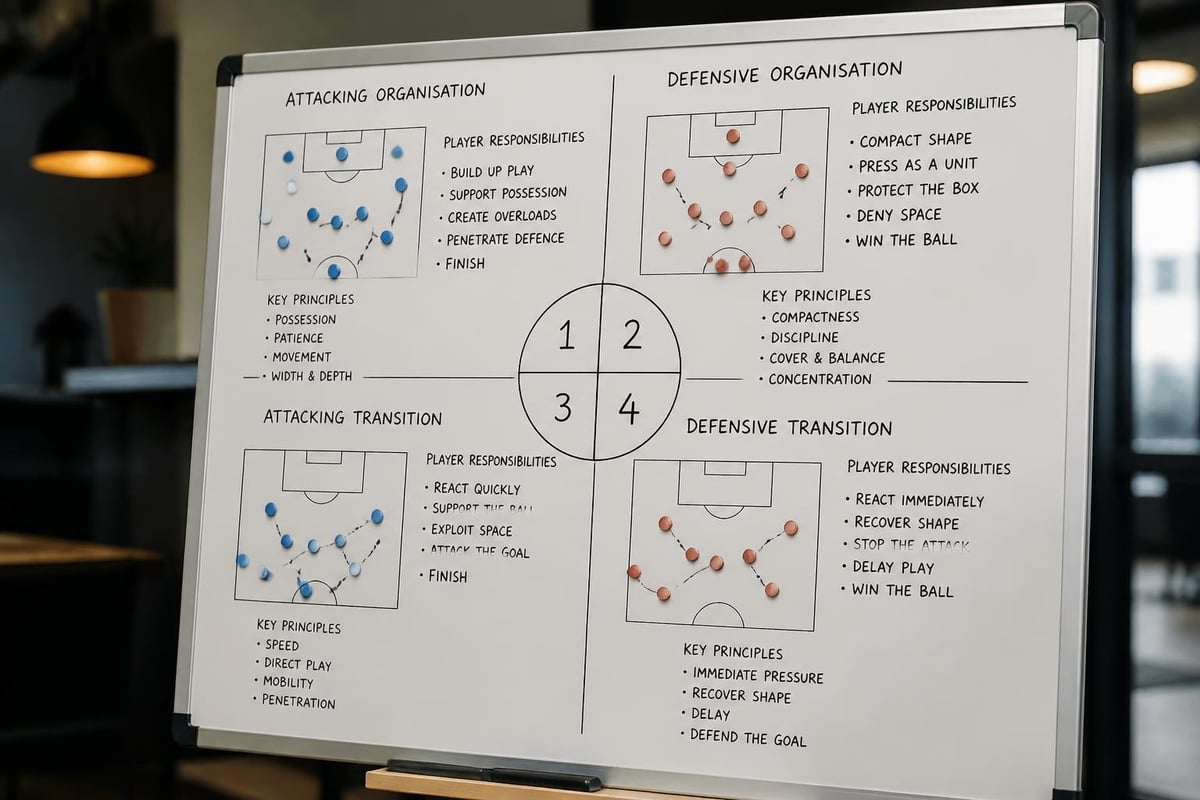
The game model should address four distinct phases:
- Attacking organization: How the team builds possession and creates scoring opportunities
- Defensive organization: Pressing triggers, defensive shape, and compactness principles
- Transition to attack: Exploiting moments when possession is won
- Transition to defense: Immediate reactions when possession is lost
Training football sessions should systematically rehearse these phases through progressive exercises. Coaches might begin with unopposed shadow play (11 players moving through patterns without opposition), then add passive defenders, semi-opposed work, and finally fully competitive scenarios.
Progressive Tactical Exercises
Effective tactical training builds complexity gradually. A session focused on building from the back might progress through:
- Technical passing patterns (goalkeeper, defenders, midfielders-unopposed)
- Building against pressing triggers (6v4 or 7v5 with directional goals)
- Full-phase play (11v11 from goalkeeper, must complete 10 passes before attempting penetration)
- Live game (scrimmage with emphasis on build-up principles)
Each progression increases decision-making complexity while maintaining the session's core learning objective. This approach keeps players engaged and allows coaches to provide specific, actionable feedback.
Equipment Considerations for Training Football Programs
Quality equipment directly impacts training effectiveness, safety, and player development. Schools, clubs, and organizations must balance budget constraints with the need for reliable, durable gear.
Essential Training Equipment Categories
Field equipment for skill development:
- Cones and markers (various colors for organization)
- Portable goals for small-sided games and shooting practice
- Agility equipment (hurdles, poles, speed ladders)
- Ball supply (sufficient for one ball per player minimum)
Conditioning and monitoring tools:
- GPS tracking units or heart rate monitors
- Timing gates for speed testing
- Medicine balls and resistance bands
- Recovery tools (foam rollers, massage equipment)
Organizations can find comprehensive football training equipment designed for daily practice demands. Investing in portable soccer goals allows coaches to maximize field space and create multiple training stations simultaneously.
Maintaining Equipment Standards
Regular equipment inspection prevents injuries and extends product lifespan. Goals should be secured properly, nets repaired promptly, and worn training balls replaced. Creating an equipment inventory and maintenance schedule ensures nothing falls through organizational cracks.
Teams should establish clear protocols for equipment setup and breakdown, often delegating responsibility to players as part of team culture development. This teaches organizational skills while reducing coach workload.
Injury Prevention and Player Welfare
The best training football program means nothing if players cannot stay healthy. Proactive injury prevention should be woven throughout session design, not treated as an afterthought.
Implementing Evidence-Based Warm-Up Protocols
Structured warm-ups reduce injury rates by 30-50% when implemented consistently. The FIFA 11+ program represents the gold standard, incorporating running exercises, strength work, plyometrics, and balance challenges in a 20-minute format.
Key warm-up principles include:
- Progressive intensity: Start with low-intensity movement, gradually increase
- Multi-planar movement: Include forward/backward, lateral, and rotational patterns
- Neuromuscular activation: Wake up stabilizing muscles before high-load activities
- Sport-specific preparation: Incorporate movements that mimic game actions
Coaches should view warm-ups as skill development opportunities rather than wasted time. Technical work can be integrated into dynamic warm-up activities, maximizing practice efficiency.
Recovery Protocols and Athlete Monitoring
Training football creates physiological stress that requires adequate recovery for adaptation to occur. Teams should implement systematic recovery protocols including:
- Cool-down routines (light jogging, static stretching)
- Nutrition guidance (immediate post-training refueling)
- Sleep education (quantity and quality recommendations)
- Active recovery sessions (pool work, yoga, low-intensity movement)
Hydration and cooling strategies become particularly important during hot weather training. Dehydration significantly impairs both physical performance and cognitive decision-making, increasing injury risk.
Simple monitoring methods help coaches identify players who may need modified workloads. Brief daily wellness questionnaires covering sleep quality, muscle soreness, stress levels, and fatigue provide valuable early warning signs of overtraining or illness.
Age-Appropriate Training Football Considerations
Training philosophies and methods must adapt to player developmental stages. What works for senior professionals often fails with youth athletes, and vice versa.
Youth Player Development Priorities
Young players (ages 6-12) should emphasize fun, fundamental movement skills, and ball mastery over tactical complexity or physical conditioning. Training sessions should include high variety, frequent water breaks, and games-based activities that maintain engagement.
As players mature (ages 13-18), training football can gradually incorporate more tactical sophistication, position specialization, and structured physical development. However, coaches must remain vigilant about growth-related injury risks and avoid overtraining during adolescent growth spurts.
Age-appropriate session characteristics:
| Age Group | Session Length | Structure | Primary Focus | Physical Load |
|---|---|---|---|---|
| 6-9 years | 45-60 min | Mostly games | Fun, basic skills | Very Low |
| 10-12 years | 60-75 min | Mixed | Ball mastery, 1v1 | Low-Moderate |
| 13-15 years | 75-90 min | Structured | Technical + tactical basics | Moderate |
| 16-18 years | 90-120 min | Systematic | Position-specific + team concepts | Moderate-High |
| Senior/Adult | 75-120 min | Periodized | Game model + physical peaks | High (managed) |
Senior and Amateur Player Adaptations
Adult amateur players typically train 2-3 times weekly compared to daily sessions at professional levels. This limited contact time requires coaches to prioritize ruthlessly-focusing on tactical cohesion and maintaining physical fitness rather than developing new technical skills.
Recovery capacity often decreases with age, requiring longer rest periods between high-intensity sessions. Training football programs for older players should emphasize injury prevention, movement quality, and sustainable load management over peak performance at all costs.
Successful training football programs combine scientific principles with practical coaching experience, creating environments where players develop physically, technically, tactically, and mentally. The most effective coaches maintain clear session objectives, implement evidence-based methods, monitor player responses, and adjust based on individual and team needs. Whether you're equipping a youth academy or a senior squad, having reliable training equipment makes implementation smoother and more effective. Sideline Sport Supply provides the game-day-ready training essentials that help coaches focus on player development rather than equipment concerns, with straightforward pricing and fast fulfillment that keeps your program running smoothly.