

Tennis Machines: A Complete Guide for Coaches and Players
Tennis machines have transformed how coaches, players, and training facilities approach skill development and practice efficiency. These automated feeding systems deliver consistent, repeatable ball trajectories that enable focused repetition without requiring a live hitting partner. For athletic programs, schools, and individual athletes seeking to maximize training time and improve stroke mechanics, understanding the capabilities, limitations, and strategic applications of tennis machines represents a critical component of modern tennis development. From recreational players building foundational skills to competitive athletes refining match-specific patterns, these tools offer unique training benefits when integrated thoughtfully into comprehensive practice plans.
Understanding Tennis Machine Technology and Capabilities
Modern tennis machines range from basic oscillating feeders to sophisticated programmable systems that replicate match conditions. Entry-level models typically launch balls at fixed intervals with adjustable speed and trajectory, providing consistent feeds for stroke repetition. Mid-range units add oscillation patterns, random placement, and variable spin options that challenge players to react and adjust positioning. Premium systems incorporate programmable sequences, wireless controls, and battery power for true portability across court locations.
The mechanical principles behind these devices have evolved significantly since early rotating-wheel designs. Contemporary machines employ dual-wheel systems that generate topspin, backspin, and slice by varying wheel speeds and contact angles. Pitch and trajectory controls allow simulation of different shot heights, from low passing shots to high defensive lobs. Frequency settings determine feed intervals, with ranges typically spanning three to twelve seconds between balls, accommodating both rapid-fire drills and recovery-focused sessions.
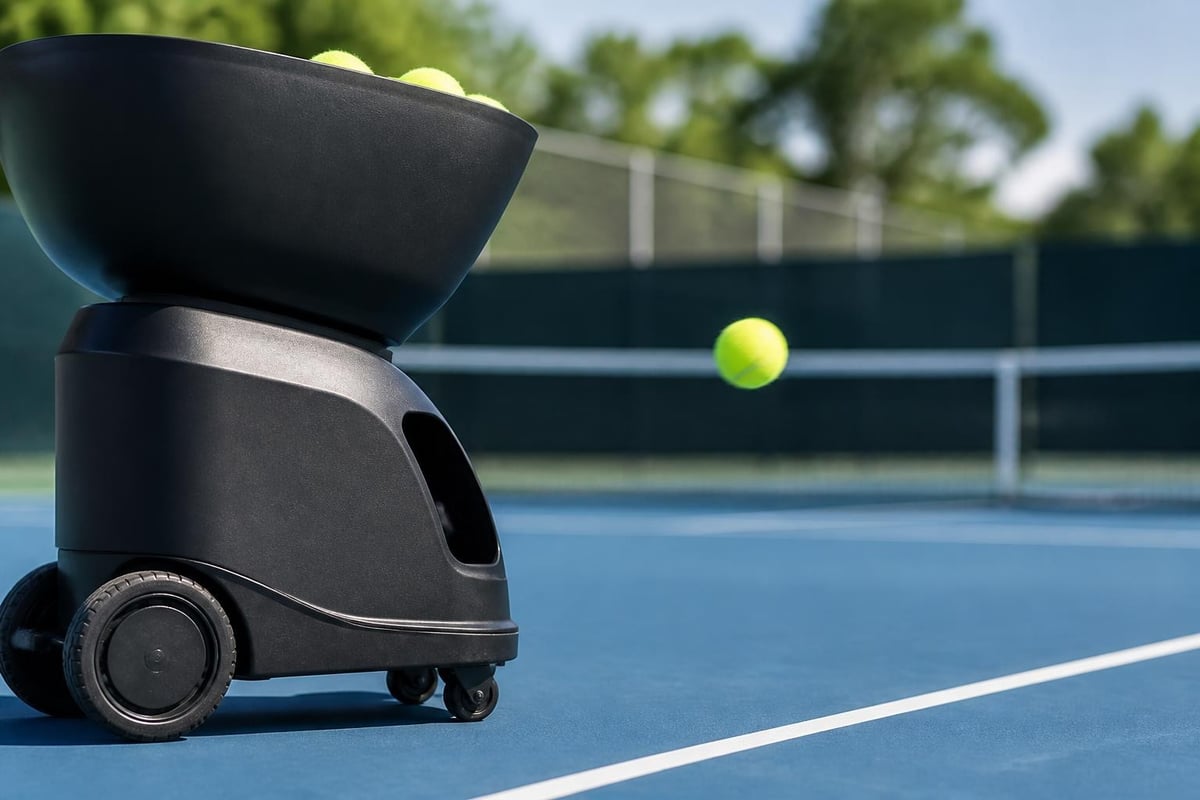
Battery technology has particularly impacted machine utility for coaches and facilities. Lithium-ion powered units eliminate extension cord limitations, enabling placement anywhere on court and supporting multi-court training programs. Recent field testing indicates that battery performance and portability considerations significantly influence practical training applications, especially for programs operating across multiple courts or outdoor facilities without convenient power access.
Capacity and Feed Rate Specifications
Ball capacity directly affects practice session length and coaching workflow. Standard hoppers hold between 50 and 150 balls, with larger commercial models accommodating 200-plus balls for extended team sessions. A 100-ball capacity at six-second intervals provides approximately ten minutes of continuous feeding, requiring coaches to plan drill duration around refill breaks.
| Machine Category | Ball Capacity | Typical Feed Rate | Session Duration | Power Source |
|---|---|---|---|---|
| Entry-level | 50-80 balls | 4-10 seconds | 3-8 minutes | AC power |
| Mid-range | 80-120 balls | 2-10 seconds | 5-15 minutes | AC or battery |
| Premium portable | 100-150 balls | 1.5-10 seconds | 8-20 minutes | Lithium battery |
| Commercial | 150-300 balls | 1-12 seconds | 15-40 minutes | AC or hybrid |
Feed rate flexibility enables varied training objectives. Rapid feeds at 1.5-second intervals challenge reaction time and footwork recovery, while slower intervals allow technical focus and full stroke completion. Coaches designing structured training programs should consider how capacity and feed rate align with specific drill objectives and available practice time.
Training Applications and Skill Development Benefits
Tennis machines excel at providing volume repetition for stroke pattern development. Players building muscle memory for groundstrokes, volleys, or overhead smashes benefit from receiving identical ball feeds repeatedly, allowing focus on technique refinement without variation introduced by human feeding inconsistency. This controlled environment proves particularly valuable during early skill acquisition phases and when correcting specific mechanical flaws.
The ability to isolate specific shots represents another key training advantage. Coaches can program machines to deliver exclusively forehand cross-courts, backhand down-the-lines, or approach shot scenarios, enabling targeted skill work. This specificity supports deliberate practice principles, where athletes focus attention on precise technical elements rather than managing the cognitive load of varied shot selection.
Research examining equipment modifications for skill development has demonstrated that ball compression and equipment scaling affect novice learning outcomes, with implications for how coaches select practice balls when using machines with beginner and intermediate players. Lower-compression balls paired with machine feeding can reduce anxiety and improve contact quality during foundational skill building.
Match Simulation and Tactical Training
Advanced machines enable pattern-based drills that approximate match situations. Programmable sequences can recreate common rally patterns, alternating short-angle balls with deep drives to simulate defensive-to-offensive transitions. Random oscillation modes challenge players to read ball direction and adjust court positioning dynamically, developing pattern recognition skills.
However, important limitations exist regarding representativeness. A landmark study found that movement initiation and swing timing differ when returning balls from machines versus real servers, suggesting that exclusive machine practice may not fully transfer to live-play scenarios. Players rely on visual cues from opponents' body position, racket preparation, and contact point when anticipating shots during actual matches. These perceptual elements remain absent in machine feeding, potentially limiting tactical skill development if machines constitute the sole practice method.
Coaches should therefore integrate machine work within broader training plans that include live hitting, point play, and match competition. Machines optimize technique refinement and conditioning, while live practice develops anticipation, shot selection, and tactical decision-making under competitive pressure.
Selecting the Right Equipment for Program Needs
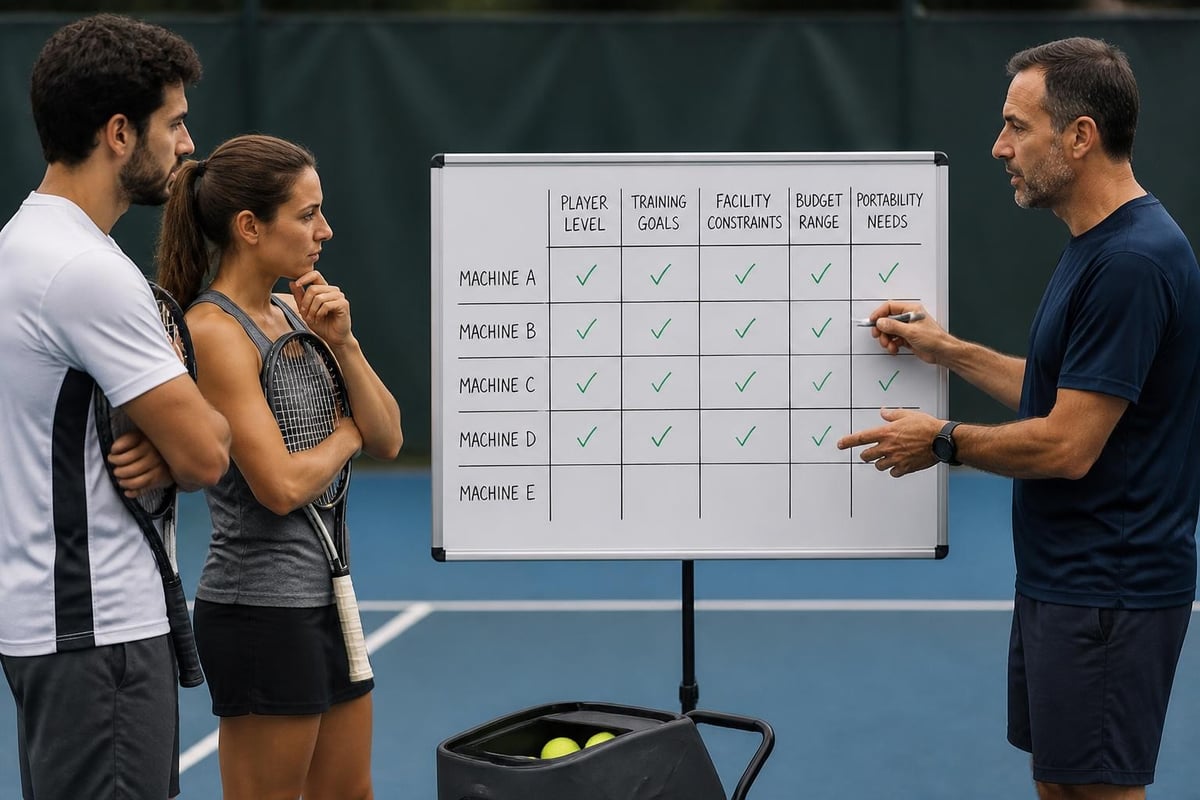
Choosing appropriate tennis machines requires evaluating program size, player skill levels, training objectives, and budget constraints. Schools and facilities serving multiple teams benefit from durable commercial units with high ball capacity and programmable features. Individual coaches or small clubs may prioritize portability and battery operation for flexible court usage.
Key selection criteria include:
- Spin generation capability: Essential for advanced players practicing specific shot responses
- Oscillation range: Wider patterns challenge footwork and court coverage
- Programmability: Custom sequences support varied drill design and progression
- Portability: Battery power and wheel systems enable multi-court deployment
- Durability: Commercial construction withstands high-volume institutional use
- Ball capacity: Larger hoppers reduce interruptions during team sessions
Budget considerations typically range from basic units under one thousand dollars to professional systems exceeding five thousand dollars. Team purchasing programs can make higher-tier equipment more accessible for schools and organizations through volume pricing and institutional billing options.
Ball Selection and Maintenance Considerations
Ball quality and type significantly impact machine performance and training effectiveness. Standard pressurized balls work well for most applications but depressurize over time, affecting bounce consistency. Pressureless practice balls maintain consistent characteristics longer and prove cost-effective for high-volume machine use, though they play differently than match balls.
The USTA's guidance on ball testing and transition ball categories provides valuable context for coaches selecting appropriate balls for different skill levels and training objectives. Low-compression balls commonly used with young players and beginners require machines capable of accommodating their different flight characteristics and bounce properties.
Research specifically examining ball compression effects on adult beginners found that scaled equipment, including modified balls used with machines, influences skill acquisition patterns and learning rates. Programs serving diverse populations should consider maintaining multiple ball types matched to player developmental stages.
Regular machine maintenance extends equipment life and ensures consistent performance. Cleaning feed wheels removes dirt and ball felt buildup that affects spin generation. Battery care protocols, including proper charging cycles and storage procedures, preserve power system longevity. Inspecting wheels, motors, and mechanical components before each season identifies wear requiring service before equipment failure disrupts training schedules.
Designing Effective Practice Sessions with Ball Machines
Strategic drill design maximizes machine training value. Effective sessions balance technical repetition with sufficient cognitive challenge to promote engagement and transfer to match play. Coaches should structure machine work within comprehensive practice plans that include varied activities addressing different skill domains.
A progressive session framework might include:
- Warm-up phase: Low-intensity feeds at moderate pace for movement preparation and contact timing
- Technical focus: Specific stroke work with consistent feeds targeting mechanical refinement
- Pattern drills: Programmed sequences simulating tactical situations and rally patterns
- Conditioning component: High-intensity feeds emphasizing recovery footwork and sustained effort
- Cool-down: Controlled-pace feeds allowing technique reinforcement under reduced fatigue
Feed difficulty should progress logically within sessions, beginning with manageable pace and placement before advancing to challenging speeds and wider angles. This progression supports motor learning principles while maintaining player confidence and motivation throughout extended practice blocks.
Integration with Live Hitting and Match Play
Balancing machine work with live practice proves essential for comprehensive development. Machines provide technical refinement and physical conditioning, while live hitting develops anticipation, shot selection, and competitive mindset. Research using machines in physiological testing protocols demonstrates their utility for standardized workload assessment, but competitive skill development requires exposure to human opponents' varied tactics and unpredictable shot execution.
A balanced weekly schedule for competitive players might allocate 30-40% of court time to machine work, 40-50% to live hitting drills and point play, and 10-20% to match simulation or actual competition. Recreational players and beginners may benefit from higher machine proportions during skill acquisition phases, gradually shifting toward more live play as foundational strokes solidify.
Coaches should also consider supplementing tennis-specific training with broader athletic development equipment that addresses movement quality, strength, and conditioning. Cross-training supports injury prevention and overall athletic capacity that transfers to on-court performance.
Facility and Program Implementation Strategies
Schools and clubs implementing machine-based training programs require thoughtful planning around equipment access, scheduling, and supervision protocols. Dedicated machine practice times allow athletes to build consistent routines while maximizing equipment utilization across multiple users. Some facilities designate specific courts for machine work during designated hours, while others integrate machines into regular practice rotations.
Storage and transport logistics merit attention, particularly for programs operating across multiple court locations. Wheeled machines with folding handles ease movement between storage areas and court positions. Weather-resistant covers protect outdoor-stored equipment from environmental damage. Battery-powered units eliminate extension cord trip hazards and enable flexible court placement without proximity constraints to electrical outlets.
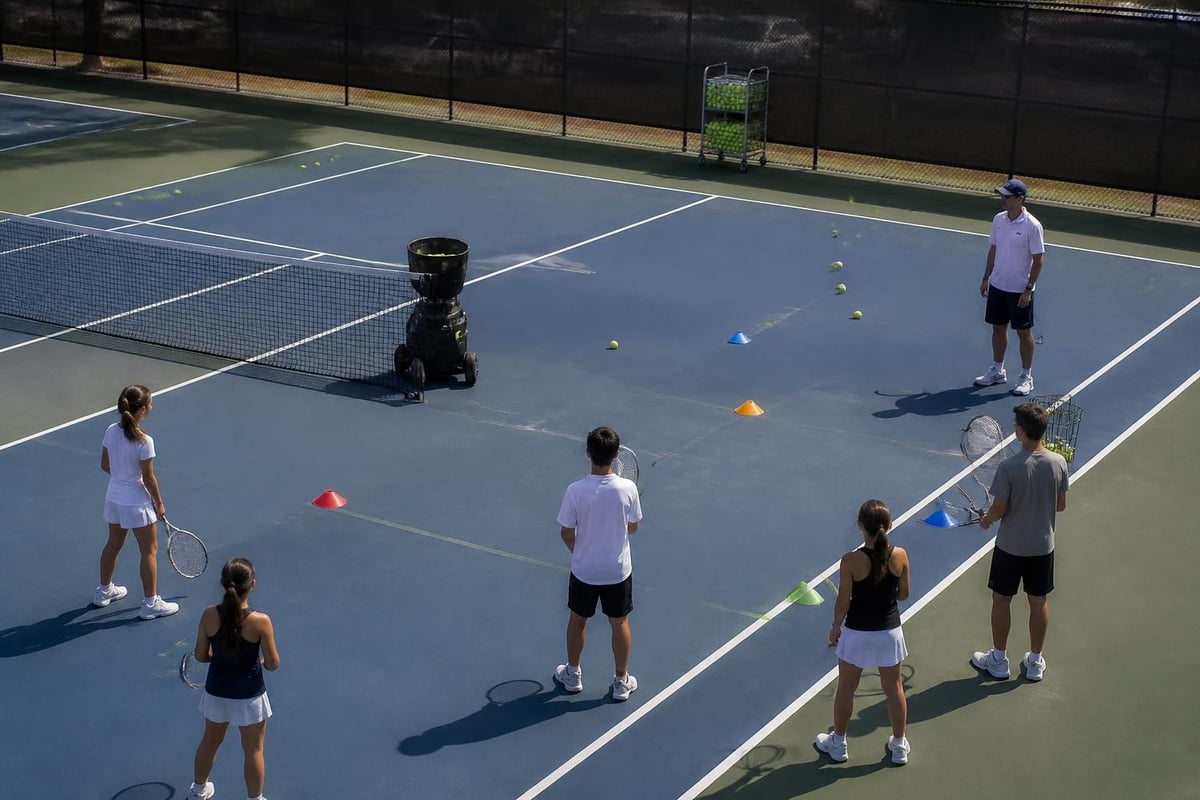
The USTA's public parks resource guide offers relevant guidance for community programs implementing equipment-based training at shared facilities. Considerations around equipment security, scheduling coordination with other user groups, and appropriate ball types for various court surfaces help optimize program operations.
Safety Protocols and Supervision Requirements
Proper safety measures prevent injuries during machine practice sessions. Clear communication about machine operation, including start/stop procedures and emergency shutdown protocols, ensures safe usage. Younger players and beginners require close supervision until demonstrating competence with equipment controls and safe ball retrieval practices.
Key safety guidelines include:
- Never reach into machine hopper or feed mechanism while unit operates
- Establish clear ball retrieval protocols with machine stopped and powered down
- Maintain appropriate distance from machine during operation
- Secure loose balls away from movement areas to prevent slip hazards
- Position machines to prevent balls from reaching adjacent courts or walkways
- Verify court clear of non-participants before initiating feeds
Facilities should develop written safety procedures and provide training for staff and athletes operating equipment. Documentation supports consistent practice across different supervisors and provides liability protection through demonstrated safety diligence.
Cost-Effectiveness and Return on Investment
Evaluating machine investment requires examining both direct costs and broader program value. Initial purchase price represents the obvious expense, but long-term considerations include maintenance, ball replacement, electricity or battery costs, and storage infrastructure. High-quality machines purchased through suppliers offering price match guarantees help programs optimize equipment budgets while securing reliable performance.
Operational efficiency gains provide significant value beyond equipment cost. A single machine enables one coach to conduct productive individual practice sessions that would otherwise require multiple hitting partners or assistant coaches. Team practices leverage machines for station work, allowing simultaneous small-group instruction while other athletes receive automated feeds. This multiplicative effect on coaching capacity represents substantial return on investment for programs with limited staff resources.
Student athlete development outcomes constitute another return dimension. Consistent machine access enables higher practice volume and more frequent skill refinement opportunities compared to solely partner-dependent practice. Players accelerate technical development through focused repetition impossible during exclusively live hitting sessions. Competitive programs often justify equipment investment through improved match results and player advancement.
| Investment Factor | Initial Cost | Annual Operating Cost | Efficiency Gain | Development Impact |
|---|---|---|---|---|
| Entry-level machine | $800-1,500 | $100-200 | Moderate | Foundational skill building |
| Mid-range portable | $1,500-3,000 | $150-300 | Significant | Broad skill application |
| Premium programmable | $3,000-5,500 | $200-400 | Substantial | Advanced tactical work |
| Commercial system | $5,000-8,000+ | $300-600 | Maximum | Comprehensive program support |
Schools and organizations can explore institutional purchasing options that spread costs across budget years or leverage group buying power for improved pricing. Grants and booster club funding provide additional acquisition pathways for programs with constrained equipment budgets.
Emerging Technologies and Future Developments
Innovation continues advancing tennis machine capabilities and applications. Artificial intelligence integration promises adaptive feeding systems that analyze player stroke patterns and automatically adjust delivery parameters to target specific improvement areas. Computer vision systems could track ball contact points and swing paths, providing real-time feedback during machine practice sessions.
Robotic ball retrieval systems represent another development area gaining traction. Recent engineering work on automated ball collection robots demonstrates technical feasibility for systems that autonomously gather practice balls and return them to machine hoppers. This automation could eliminate manual pickup interruptions, dramatically increasing practice efficiency and session duration.
Connectivity features enable remote programming and performance tracking through smartphone applications. Coaches could design custom drill sequences off-court and upload programs wirelessly, while cloud storage preserves library of proven training routines accessible across multiple machines. Usage tracking provides data on practice volume, helping coaches and athletes monitor training consistency over time.
Physical design improvements focus on enhanced portability and extended battery life. Lighter composite materials reduce equipment weight without sacrificing durability, while higher-capacity lithium systems extend cordless operation to multi-hour sessions. Solar charging integration could support outdoor facilities in sunny climates, reducing operating costs and environmental impact.
Broader Equipment Ecosystem Integration
Tennis machines increasingly function within comprehensive training equipment systems. Coaches combine machine work with portable ball carts, target markers, agility ladders, and court dividers to create multi-station practice environments. This integration mirrors approaches used in other sports, similar to how facilities deploy baseball and softball pitching machines alongside batting tees, protective screens, and field equipment for complete practice setups.
Cross-sport facilities serving multiple athletic programs benefit from suppliers offering diverse equipment categories under unified procurement and support. Organizations can streamline purchasing processes while ensuring equipment compatibility and consistent quality standards across different sports disciplines. This systems approach simplifies facility management and budget planning compared to sourcing each equipment category independently.
Technical facility infrastructure, including court surfacing, net systems, and player amenities, works synergistically with training equipment to create optimal development environments. Professional guidance on facility equipment standards helps programs make informed decisions about infrastructure investments that support long-term athletic development goals.
Practical Recommendations for Coaches and Athletes
Maximizing tennis machine value requires intentional integration within comprehensive training philosophies. Coaches should view machines as tools for specific applications rather than complete practice solutions. Technical refinement, volume repetition, and physical conditioning represent ideal use cases, while tactical development and competitive preparation demand live-play components.
Athletes training independently with machines should maintain clear technical focus during each session. Recording practice videos for later review helps identify mechanical issues invisible during real-time execution. Varying drill difficulty prevents stagnation and maintains engagement across repeated sessions. Setting specific performance targets, such as successful completion percentage or rally length goals, adds competitive elements to solo practice.
Program administrators evaluating equipment needs should conduct thorough research including hands-on demonstrations when possible. Speaking with peer programs using specific models provides practical insight beyond manufacturer specifications. Requesting trial periods or rental options allows testing equipment under actual program conditions before committing to purchase.
Budget-conscious programs should prioritize features most critical for their specific player population and training objectives. Beginning programs serving recreational players may find entry-level machines adequate for foundational work, while competitive programs benefit from investing in programmable systems supporting advanced tactical training. Used equipment markets offer cost-saving opportunities, though buyers should carefully assess mechanical condition and remaining service life.
Documentation and training protocols ensure consistent, safe equipment usage across staff and athletes. Creating standardized operating procedures, maintenance checklists, and drill libraries supports program continuity during coaching transitions. Digital resources and video tutorials help new users develop competence quickly without relying solely on person-to-person training.
Athletes and coaches seeking reliable equipment sources should evaluate suppliers based on product selection, pricing transparency, and customer support capabilities. Working with established athletic equipment providers ensures access to quality products backed by knowledgeable service and straightforward purchasing processes. Strong supplier relationships facilitate timely equipment replacement, technical assistance, and program-specific recommendations that evolve with changing needs.
Tennis machines offer powerful capabilities for structured skill development, technical refinement, and efficient practice when integrated thoughtfully into comprehensive training programs. Understanding equipment specifications, training applications, and implementation strategies enables coaches, athletes, and administrators to leverage these tools effectively while recognizing their appropriate role alongside live hitting and competitive play. Whether building foundational strokes with beginners or refining match-specific patterns with advanced competitors, strategic machine use supports player development at every level. Sideline Sport Supply provides the reliable training equipment, straightforward pricing, and responsive support that athletic programs need to focus on what matters most: developing athletes and competing at their highest level.