

Tennis Equipment Guide: Racquets, Balls & Court Essentials
Selecting the right tennis equipment makes the difference between frustration and performance on the court. Whether you're outfitting a school program, stocking a community facility, or helping athletes train effectively, understanding the full range of tennis gear ensures players can develop their skills without unnecessary obstacles. From racquets and balls to court systems and training aids, every piece of equipment serves a specific purpose in creating successful tennis programs that keep athletes engaged and progressing.
Understanding Tennis Racquet Fundamentals
The racquet stands as the most personal piece of tennis equipment any player will select. Modern racquets vary dramatically in weight, balance, head size, and string pattern, with each specification affecting how the racquet performs during play.
Head size directly influences the sweet spot and power generation. Larger head sizes (105-135 square inches) provide more forgiveness for recreational players and beginners, while smaller heads (85-98 square inches) offer precision for advanced competitors. Mid-size options (98-104 square inches) balance power and control for intermediate development.
Weight distribution matters significantly for player comfort and injury prevention. Research shows that tennis equipment and technique interactions influence overuse injury risk, making proper racquet selection essential for long-term player health.
Racquet Specifications That Matter
When sourcing racquets for teams or programs, consider these key specifications:
- Weight range: 240-340 grams unstrung
- Balance point: Head-heavy, even, or head-light
- Beam width: Affects stiffness and power
- String pattern: Open (16x19) for spin, dense (18x20) for control
- Grip size: 4" to 4 5/8" for proper hand fit
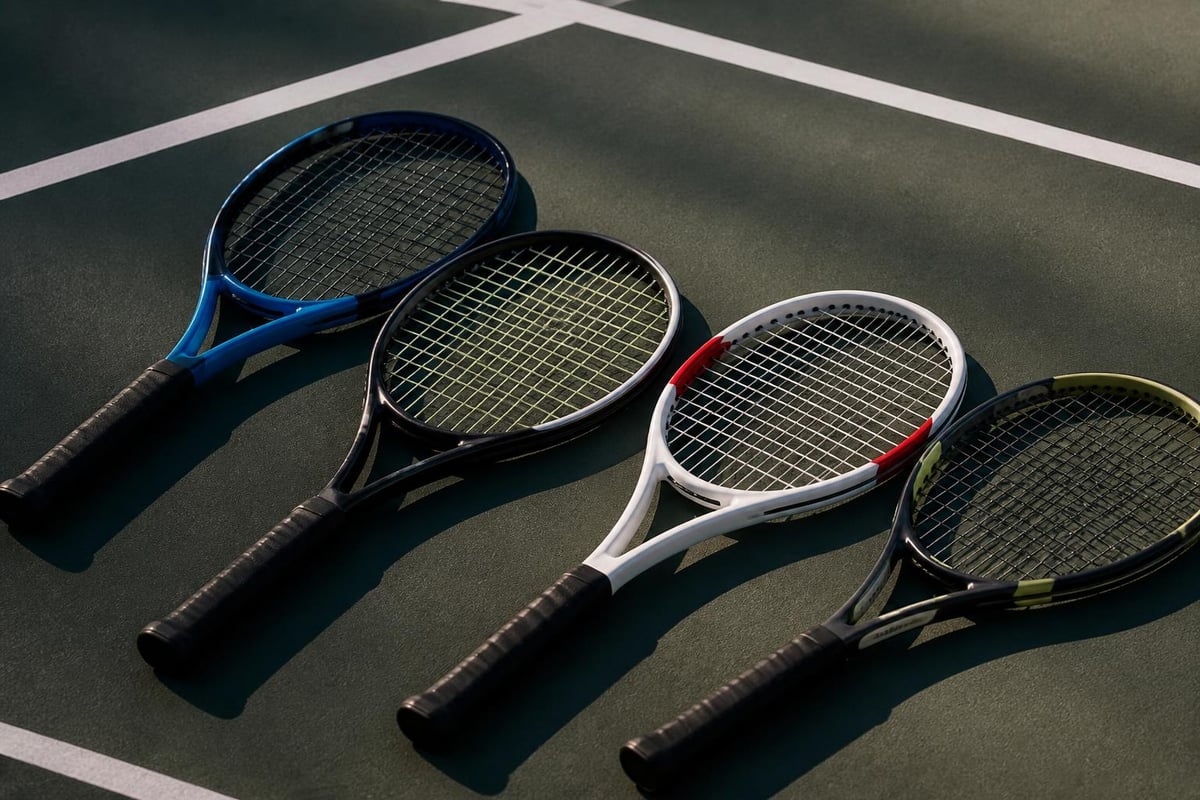
Programs serving multiple skill levels benefit from maintaining inventory across specification ranges. Junior players require lighter frames (220-270 grams), while competitive adult programs need access to heavier, more precise equipment.
Tennis Ball Selection for Different Surfaces and Skill Levels
Not all tennis balls perform equally across different court surfaces and player abilities. The right ball selection enhances practice quality and extends equipment longevity.
Ball Type Comparison
| Ball Type | Best For | Durability | Price Point |
|---|---|---|---|
| Pressurized | Competition, hard courts | 2-3 sessions | Higher |
| Pressureless | Practice, teaching, ball machines | 3-6 months | Lower |
| Low compression | Junior development, beginners | Moderate | Moderate |
| High altitude | Facilities above 4000 feet | Similar to standard | Standard |
Pressurized balls deliver consistent bounce and feel, making them essential for matches and competitive training. However, they lose pressure over time, making pressureless options more economical for high-volume practice sessions.
Low compression balls serve specific developmental purposes. These balls travel slower through the air and bounce lower, giving beginners more time to set up shots and develop proper technique. The beginner's guide to essential tennis equipment emphasizes starting with appropriate ball types for skill development.
Court surface dramatically affects ball wear. Hard courts create more abrasion, shortening ball life compared to clay or grass surfaces. Programs should budget approximately one can (3-4 balls) per player every two weeks for regular practice schedules on hard courts.
Court Equipment and Net Systems
Permanent and portable court equipment forms the foundation of any tennis facility. Proper installation and maintenance of nets, posts, and court accessories ensures safe, regulation play.
Professional Net Systems
Quality tennis post systems must meet specific dimensional requirements. Regulation nets measure 42 feet in length for doubles play, with a height of 3.5 feet at the posts and 3 feet at the center. Posts should be positioned 3 feet outside the doubles sideline.
Permanent systems offer superior stability but require professional installation. These systems typically feature:
- Ground sleeve installation for secure mounting
- Stainless steel or aluminum construction for weather resistance
- Integrated winding mechanisms for net tensioning
- Removable posts for multi-sport facilities
Portable systems provide flexibility for facilities serving multiple sports or temporary court setups. Quality portable posts use weighted bases (150+ pounds each) to prevent tipping during play and windy conditions.
Court Accessories and Maintenance Equipment
Beyond nets and posts, functional tennis facilities require additional equipment:
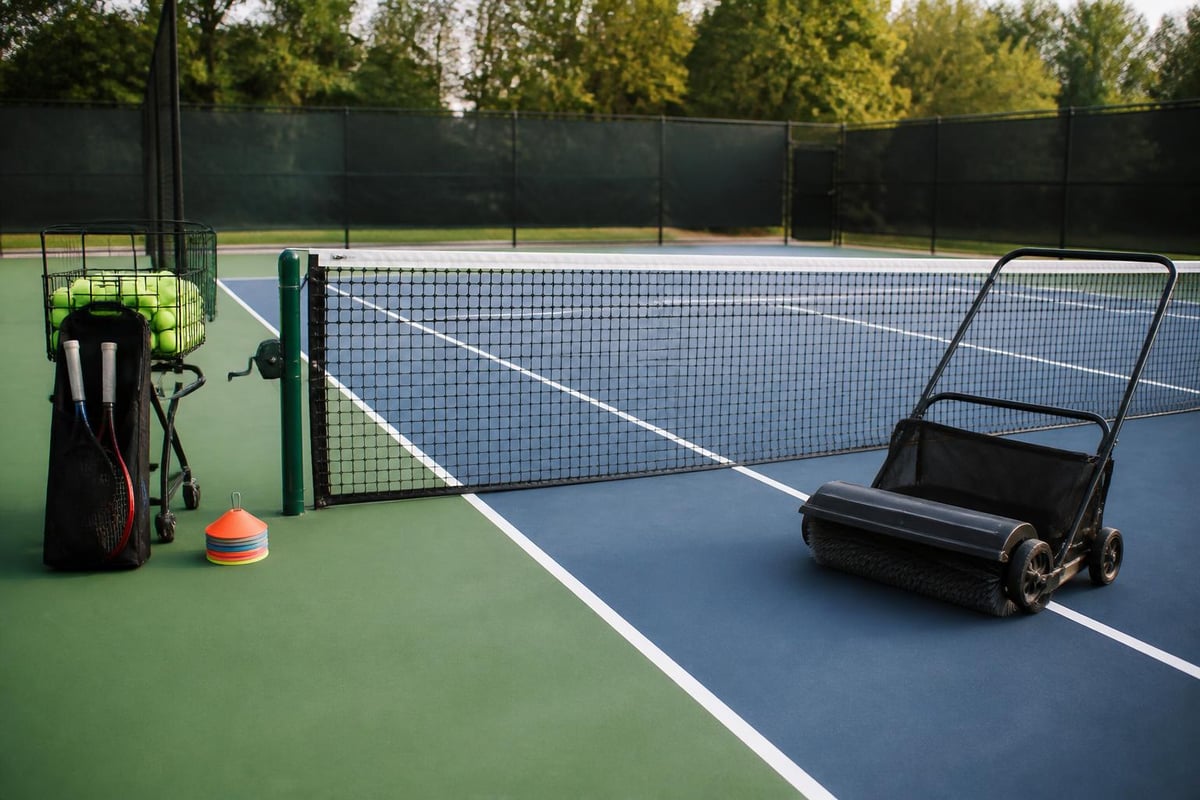
- Court sweepers for surface maintenance
- Line tape for temporary court marking
- Windscreens for player comfort and ball visibility
- Ball hoppers for efficient practice sessions
- Court squeegees for water removal
Regular surface maintenance extends court life and prevents injuries. Hard court surfaces benefit from pressure washing annually, while clay courts require daily brushing and periodic top dressing.
Footwear and Apparel Considerations
Proper footwear prevents injuries and enhances court performance. Tennis shoes differ significantly from general athletic shoes, with specific design elements for lateral movement and court surface interaction.
Surface-specific shoes optimize traction and durability. Hard court shoes feature durable outsoles with modified herringbone patterns, while clay court shoes use full herringbone treads to prevent clay accumulation. All-court shoes provide versatility for facilities with multiple surface types.
Key footwear features include:
- Lateral support structures to prevent ankle rolling
- Toe reinforcement for drag protection during serves
- Cushioned midsoles for impact absorption
- Breathable uppers for temperature regulation
For coaches and facility managers, understanding how to choose the perfect tennis shoes based on playing surface and foot type helps guide athletes toward appropriate selections that reduce injury risk.
Apparel for tennis equipment programs should prioritize moisture-wicking fabrics, unrestricted movement, and durability through repeated washing. Teams benefit from standardized apparel that creates cohesion while allowing individual comfort preferences in fit and style.
Training Aids and Practice Equipment
Structured practice requires more than just racquets and balls. Training aids help players develop specific skills and maintain engagement during repetition-heavy sessions.
Ball Machines and Feeding Systems
Ball machines transform practice efficiency by delivering consistent feeds without requiring a hitting partner. Modern machines offer programmable sequences, variable spin, and oscillating feeds that simulate match conditions.
When evaluating ball machines for team use, consider:
- Ball capacity: 50-300 balls depending on practice format
- Speed range: Beginner settings (10-40 mph) through advanced (40-80 mph)
- Oscillation patterns: Random, horizontal, vertical combinations
- Portability: Wheeled designs for easy court positioning
- Power source: Battery versus AC for facility flexibility
Similar to equipment available in other sports categories at Sideline Sport Supply, tennis training equipment should balance functionality with straightforward operation that doesn't require extensive technical knowledge.
Court Targets and Skill Development Tools
Precision training requires visual targets and measurement tools. Court targets help players develop shot placement accuracy through immediate visual feedback.
| Training Tool | Skill Development | Best For |
|---|---|---|
| Ground targets | Depth control, consistency | All levels |
| Net targets | Volley placement, touch | Intermediate+ |
| Serve targets | Service accuracy, placement | All levels |
| Agility ladders | Footwork, court movement | All levels |
| Resistance bands | Stroke mechanics, strength | Advanced |
Rebounders create self-sufficient practice opportunities for individual training. These angled nets return balls to players, allowing stroke repetition without ball collection breaks. Quality rebounders adjust angle and tension to modify return speed and trajectory.
Coaches building comprehensive training programs need varied equipment that addresses technical, tactical, and physical development. The fitness and training equipment category demonstrates how cross-sport training tools complement sport-specific tennis equipment.
Stringing Equipment and Racquet Maintenance
Maintaining tennis equipment extends its useful life and ensures consistent performance. String tension and condition directly affect how racquets play, making regular restringing essential for serious players.
String Selection and Tensioning
String choice influences power, control, spin, and durability. Natural gut provides superior feel and tension maintenance but costs significantly more than synthetic alternatives. Polyester strings offer durability and spin potential, while multifilament synthetics balance performance and value.
Recommended restringing frequency follows this guideline: String as many times per year as you play per week. A player practicing three times weekly should restring quarterly, even if strings haven't broken.
Tension specifications vary by player preference and string type:
- Beginners: 50-55 pounds for easier power generation
- Intermediate: 55-60 pounds for balanced performance
- Advanced: 55-65 pounds for precise control
Teams managing their own stringing need quality machines, calibrated tensioning systems, and proper string clamps. Digital machines provide consistency across multiple racquets, while manual crank machines offer portability and lower initial investment.
Equipment Storage and Organization Systems
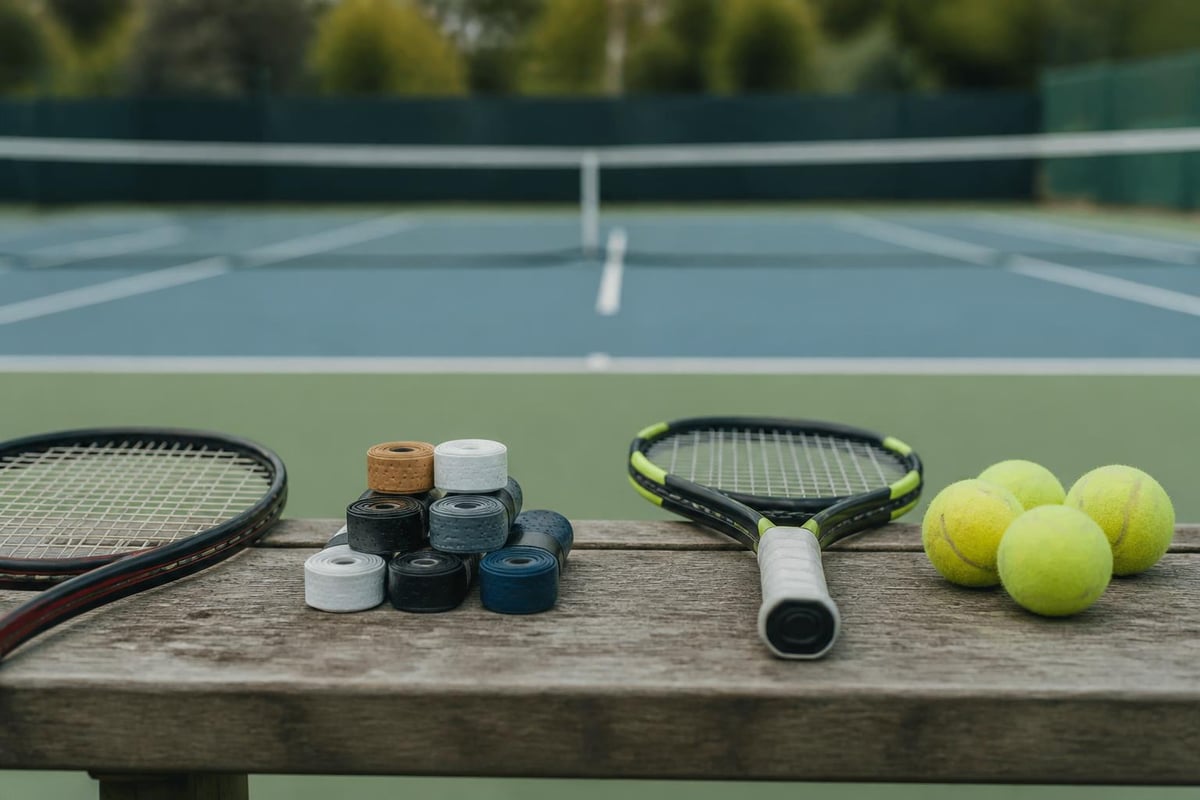
Proper storage protects tennis equipment investments and streamlines practice setup. Organized systems reduce equipment loss and ensure quick access during training sessions.
Racquet storage should protect frames from temperature extremes and physical damage. Wall-mounted racks keep racquets off the floor while allowing visual inventory checks. For programs with significant equipment quantities, rolling carts enable transportation between storage and courts.
Ball management presents unique challenges due to volume. Consider these storage solutions:
- Mesh ball bags for temporary practice ball collection
- Ball carts with rigid construction for organized storage
- Pressurized ball tubes to maintain unused ball quality
- Ball storage containers separated by condition (new, practice, retired)
Climate-controlled storage prevents racquet warping and string degradation. Extreme heat (above 90°F) and humidity accelerate string tension loss and can damage racquet frames. Facilities in varying climates should store equipment in temperature-stable environments rather than uninsulated storage sheds.
Facility Equipment for Tennis Programs
Complete tennis programs require infrastructure beyond individual player gear. Facility-level equipment creates professional environments that enhance player experience and operational efficiency.
Court Preparation and Maintenance
Year-round playability depends on proper surface maintenance equipment. Hard courts need regular cleaning to remove debris and prevent surface breakdown. Professional-grade equipment includes:
- Pressure washers (minimum 3000 PSI) for deep cleaning
- Surface repair compounds for crack filling
- Court paint with proper acrylic formulation
- Line painting machines for accurate court marking
Clay court facilities require specialized equipment including drag mats, rollers, and watering systems. Daily maintenance prevents surface irregularities that affect ball bounce consistency.
Spectator and Player Amenities
Professional facilities invest in player comfort equipment that distinguishes their programs. Quality benches, shade structures, and hydration stations create positive training environments. Water cooler systems and towel service demonstrate attention to player needs beyond basic court provision.
The outdoor equipment collection shows how facility-level infrastructure complements sport-specific gear to create complete athletic environments.
Budgeting and Equipment Lifecycle Planning
Strategic tennis equipment purchasing balances immediate needs against long-term program sustainability. Annual equipment budgets should allocate funds across multiple categories to prevent budget spikes when major items require replacement.
Sample Annual Equipment Budget Allocation
| Category | Percentage | Typical Items |
|---|---|---|
| Racquets | 30% | Demo racquets, program inventory |
| Balls | 25% | Practice and match balls |
| Court equipment | 20% | Net replacement, court maintenance |
| Training aids | 15% | Ball machines, targets, accessories |
| Apparel/footwear | 10% | Team uniforms, coaching attire |
Programs serving 50+ athletes should maintain emergency equipment reserves equivalent to 10% of their primary inventory. This buffer prevents practice cancellations when equipment fails unexpectedly.
Lifecycle planning prevents equipment degradation from undermining program quality. Establish replacement schedules based on use intensity:
- Competitive racquets: 2-3 years with regular play
- Practice balls: Replace monthly with daily use
- Net systems: 5-7 years for quality installations
- Ball machines: 7-10 years with proper maintenance
Group purchasing through established suppliers provides volume discounts and consistent equipment availability. Building relationships with reliable vendors ensures priority access during peak season demand and reduces procurement time for urgent needs.
Schools and organizations can leverage institutional purchasing agreements and educational discounts that reduce per-unit costs significantly. Many manufacturers offer specific pricing structures for verified educational and nonprofit athletic programs.
Equipping a tennis program with the right gear requires balancing performance needs, budget constraints, and long-term equipment lifecycle planning across racquets, balls, court systems, and training aids. Whether you're starting a new program or upgrading existing equipment, Sideline Sport Supply provides straightforward access to quality tennis equipment and training essentials that keep athletes focused on skill development rather than gear complications.