

Basketball Systems: Building Winning Team Strategies
Basketball systems form the backbone of successful team play at every competitive level. Whether coaching youth leagues, high school programs, or elite travel teams, implementing structured offensive and defensive frameworks transforms individual talent into cohesive, predictable team performance. Understanding how basketball systems work, how to select the right approach for your roster, and how to practice these concepts efficiently separates good teams from championship-caliber squads. For coaches, athletic directors, and sports organizations, mastering system-based basketball requires both tactical knowledge and the right training equipment to bring these concepts to life during practice sessions.
Understanding Basketball Systems and Their Core Components
Basketball systems represent organized frameworks that dictate how players move, space the floor, defend opponents, and execute during live game situations. These systems provide repeatable patterns that players can recognize and execute under pressure, reducing confusion and maximizing efficiency on both ends of the court.
Offensive System Fundamentals
Offensive basketball systems typically fall into several broad categories, each designed around different principles of ball movement, player strengths, and spacing concepts.
Motion offense emphasizes continuous player and ball movement without set plays, relying on reads, screens, and cutting principles. This system works exceptionally well for teams with multiple skilled players who can handle, pass, and shoot from various positions.
Set plays and structured offense provide predetermined actions triggered by specific calls or situations. These systems give coaches maximum control over shot selection and matchup exploitation, particularly valuable in late-game scenarios or against superior athletes.
Transition-focused systems prioritize speed and early offense before defenses can set up. Teams emphasizing this approach invest heavily in conditioning, ball pressure defense, and offensive rebounding to create additional possessions.
The official basketball rules governing shot clock duration, three-second violations, and backcourt timing directly influence which offensive systems coaches select, particularly when coaching under FIBA versus domestic competition rules.
Defensive System Categories
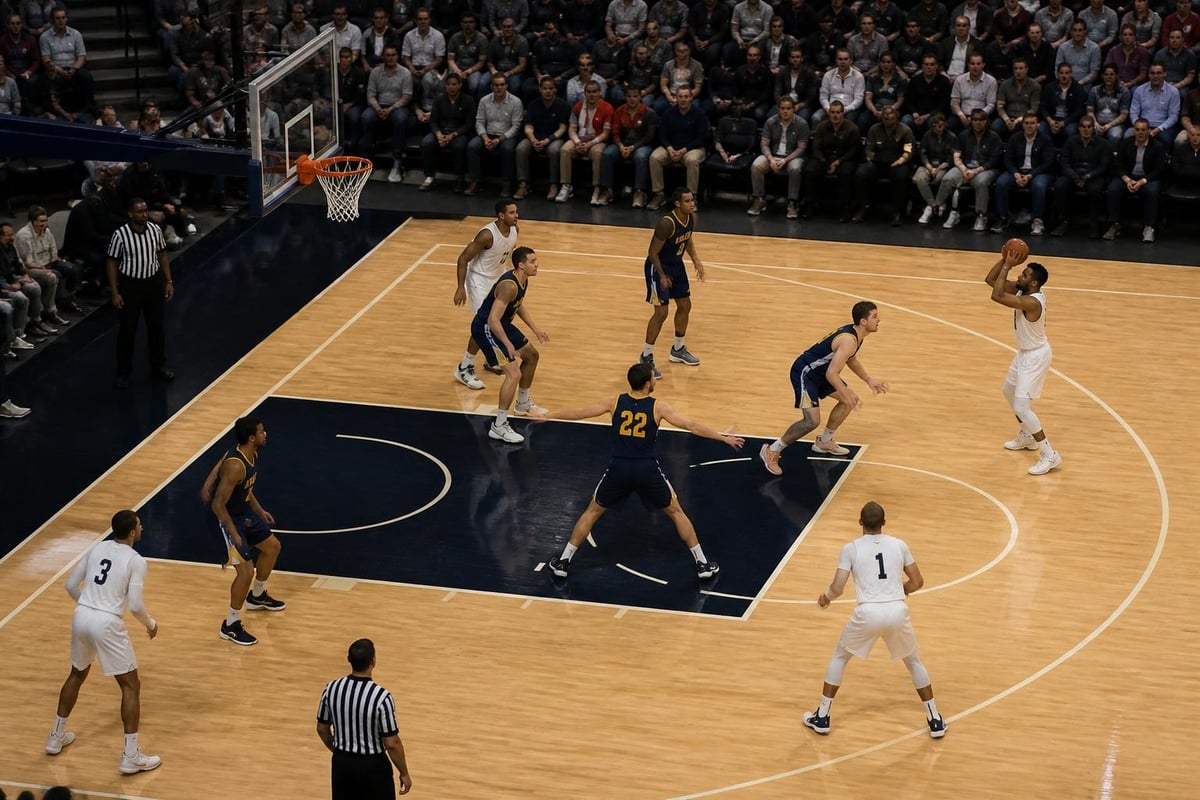
Defensive basketball systems must account for opponent strengths, your team's athletic profile, and foul trouble management throughout games.
- Man-to-man defense assigns each defender a specific offensive player, emphasizing individual accountability and on-ball pressure
- Zone defense divides the court into areas of responsibility, protecting the paint and forcing perimeter shooting
- Hybrid systems blend man principles with zone structures, such as matchup zones or box-and-one specialty defenses
- Pressure defense applies full-court or three-quarter-court traps to speed up opponents and force turnovers
Each defensive system requires different physical demands, communication protocols, and practice time investments. Coaches must evaluate their roster's lateral quickness, basketball IQ, and conditioning levels when selecting primary defensive frameworks.
Implementing Basketball Systems Through Practice Design
Effective implementation of basketball systems requires structured practice plans that progress from fundamental skill work through competitive game-speed repetitions. The transition from teaching concepts to executing under pressure determines whether systems translate from practice to game performance.
Skill Development Within System Context
Rather than isolating skills in generic drills, effective coaches embed fundamental work directly into system-specific actions. A team running pick-and-roll heavy offense should dedicate significant practice time to ball-handler footwork, screener angles, and read progression within those exact actions.
| Practice Component | Time Allocation | System Integration |
|---|---|---|
| Individual skill work | 15-20% | Contextualized to system positions |
| Small-sided games | 25-30% | 2v2, 3v3 emphasizing system reads |
| Team offense | 20-25% | Full system installation and refinement |
| Team defense | 20-25% | System rotations and communication |
| Conditioning | 10-15% | Game-speed, system-specific movements |
Coaches working with youth and developing players can reference USA Basketball's coaching curriculum for age-appropriate progressions that build system understanding alongside fundamental skills.
Progressive System Installation
Basketball systems should never be installed all at once. Successful coaches layer concepts across weeks and months, ensuring players master foundational principles before adding complexity.
Week 1-2: Core spacing rules, basic cuts, and primary actions
Week 3-4: Secondary breaks, counters, and defensive rotations
Week 5-6: Situational applications, press breaks, and ATO plays
Week 7+: Refinement, opponent-specific adjustments, and advanced options
Quality training equipment significantly accelerates system learning. Multi-purpose equipment wagons help coaches efficiently organize and transport the balls, cones, and markers needed for station-based system work during practice sessions.
Analyzing System Effectiveness Through Modern Metrics
Measuring whether basketball systems actually improve team performance requires objective analysis beyond simple win-loss records. Modern basketball analytics provide coaches with possession-based metrics that isolate system efficiency from individual talent disparities.
Key Performance Indicators for System Evaluation
Offensive and defensive ratings measure points scored or allowed per 100 possessions, providing true efficiency metrics independent of game pace. Teams can objectively track whether system changes improve scoring efficiency or defensive resistance over time.
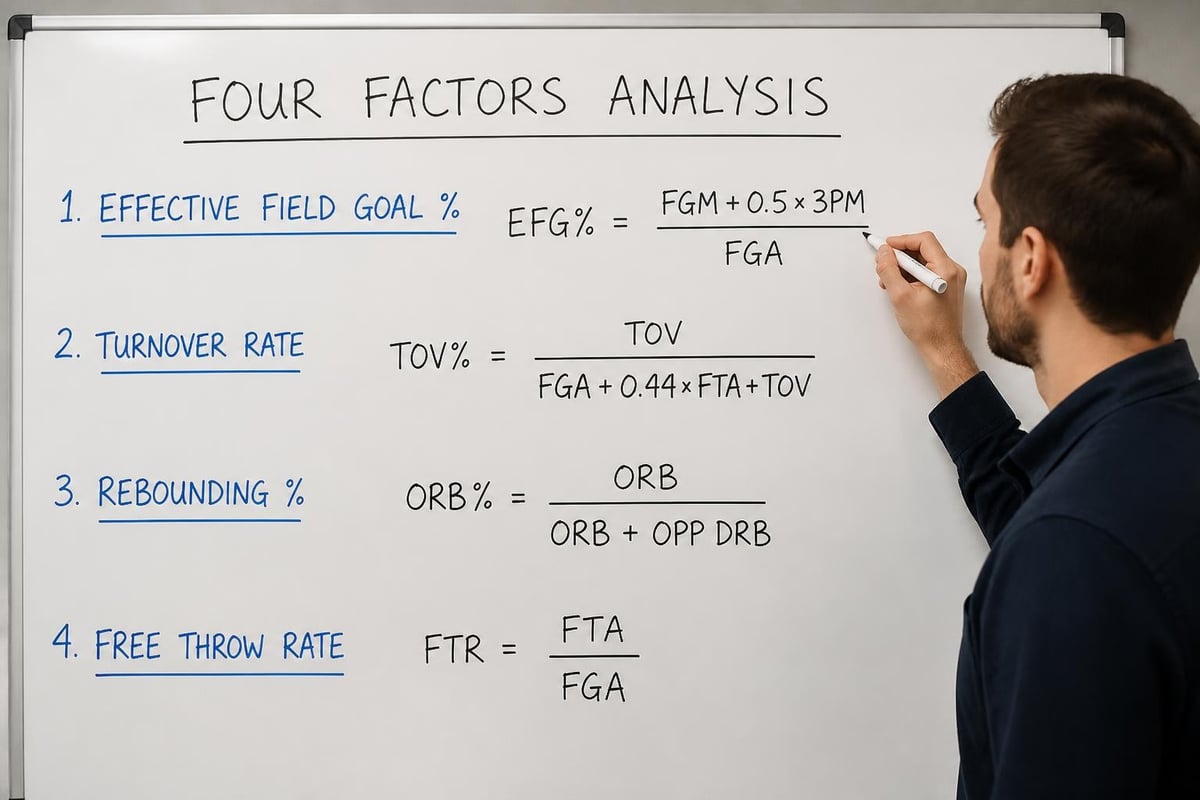
The Four Factors framework breaks team performance into:
- Effective field goal percentage (accounting for three-point value)
- Turnover rate (possessions lost per 100 opportunities)
- Offensive rebounding percentage (second-chance creation)
- Free throw rate (ability to get to the line)
Coaches implementing new basketball systems should establish baseline measurements in these areas, then track changes as system installation progresses throughout the season. This data-driven approach identifies which system elements succeed and which require adjustment or additional practice emphasis.
Advanced Spatial and Tactical Analytics
Elite programs increasingly leverage spatial tracking data and lineup optimization to refine basketball systems mid-season. Research presented at forums like the MIT Sloan Sports Analytics Conference demonstrates how shot location data, defensive positioning metrics, and lineup combinations reveal system strengths and weaknesses invisible to traditional statistics.
Coaches without access to professional tracking technology can manually chart simplified versions:
- Shot location charts identifying system-generated looks versus broken-play attempts
- Defensive closeout distances and contest rates on perimeter shots
- Transition frequency and efficiency compared to halfcourt possessions
- Turnover classification by type (live ball versus dead ball) and system phase
This analytical rigor transforms basketball systems from abstract concepts into measurable, improvable frameworks.
Screen-Based Actions and Pick-and-Roll Systems
The pick-and-roll represents the most common and versatile action within modern basketball systems, creating advantages through screening angles, defensive coverage decisions, and spacing manipulation. Understanding pick-and-roll principles and coverage schemes proves essential for both offensive system design and defensive preparation.
Offensive Pick-and-Roll Execution
Effective pick-and-roll systems require precise screening technique, proper spacing from non-involved players, and clear read progressions for both ball-handler and screener. The NBA's video rulebook on screens provides definitive examples of legal screening positions that coaches must teach to avoid offensive fouls that kill possessions.
Ball-handler reads:
- Reject the screen if defender goes under or shows early
- Turn the corner if defender trails over the screen
- Pull-up jump shot if defender drops coverage
- Pocket pass to roller if help arrives from weak side
Screener reads:
- Roll hard to rim if defensive big drops or hedges
- Pop to perimeter if defender switches and ball-handler is trapped
- Slip early if defender shows aggressive hedge before contact
- Short roll to elbow if help defenders collapse
Teams can practice pick-and-roll actions using electronic scoreboards set to game clock scenarios, building decision-making speed under time pressure.
Defensive Pick-and-Roll Coverage
Basketball systems must prepare multiple pick-and-roll defensive coverages to handle different offensive personnel and game situations. No single coverage works against all opponent actions.
| Coverage Type | Primary Goal | Best Against | Weakness |
|---|---|---|---|
| Ice/Blue | Force baseline, no middle penetration | Poor ball-handlers | Strong finishing guards |
| Switch | Eliminate separation | Similar-sized lineups | Mismatches with size disparities |
| Hedge-and-recover | Contain ball-handler, prevent shots | Scoring guards | Passing guards who find rollers |
| Drop/Contain | Protect paint, concede midrange | Non-shooters | Elite pull-up shooters |
| Blitz/Trap | Force turnover, take ball away | Ball-dominant players | Quick decision-makers |
Coaches must drill defensive communication and recognition to execute coverage adjustments seamlessly during live play. Research on tactical adjustments during competition demonstrates that teams prepared with multiple coverage options outperform those relying on single defensive schemes.
Zone Defense Systems and Their Strategic Applications
Zone basketball systems offer strategic alternatives when man-to-man defense proves disadvantageous due to foul trouble, athletic mismatches, or opponent shooting profiles. Understanding zone structures, their strengths, and their vulnerabilities allows coaches to deploy these systems strategically rather than desperately.
Common Zone Configurations
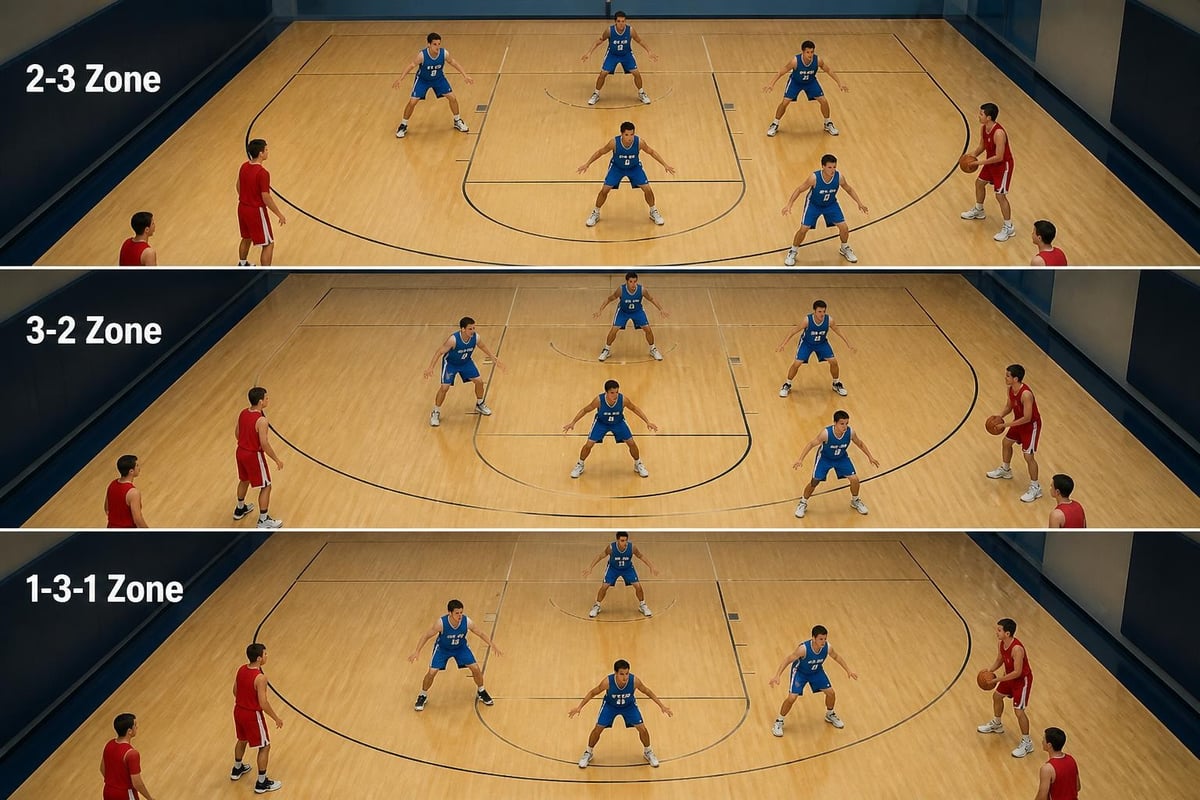
2-3 zone positions two defenders at the free-throw line extended with three across the baseline, prioritizing paint protection and defensive rebounding. This configuration works well against poor perimeter shooting teams and protects undersized posts.
3-2 zone extends three defenders to the perimeter with two protecting the paint, designed to pressure outside shooters while maintaining interior help. Teams facing elite three-point shooting often employ this structure to force contested perimeter attempts.
1-3-1 zone features a point defender, three across the free-throw line, and one deep baseline defender, creating excellent trapping opportunities in corners while maintaining weakside rebounding position.
Teaching Zone Principles
Zone basketball systems require different teaching emphasis than man-to-man concepts. Rather than individual matchup responsibility, zone defenders must learn:
- Gap integrity: Maintaining proper spacing between defenders to prevent seams
- Ball vision: Keeping eyes on both the ball and assigned area simultaneously
- Help positioning: Shrinking toward the ball while remaining available to closeout
- Rebound responsibility: Boxing out the nearest opponent rather than assigned man
Video resources from the FIBA coaching library include excellent zone teaching progressions from international coaches who frequently employ these systems in competition.
Training Equipment Supporting System Development
Implementing basketball systems effectively requires appropriate training equipment that allows coaches to simulate game scenarios, organize efficient practice flows, and develop player conditioning within system-specific movement patterns.
Essential Practice Equipment
Quality practice equipment accelerates system installation by maximizing repetitions and providing game-realistic training environments. Sideline Sport Supply specializes in the practical, durable gear coaches need for daily system work.
Portable training aids include:
- Adjustable markers and cones for spacing templates and cutting lanes
- Agility ladders and hurdles for defensive footwork circuits
- Resistance bands for closeout and contest training
- Shooting machines for high-volume system-specific spot work
Hydration and Recovery Infrastructure
Basketball systems demand significant conditioning as players execute continuous movement patterns throughout practice. Proper hydration infrastructure proves essential for maintaining practice intensity and player health.
Teams running up-tempo transition systems or pressure defense benefit significantly from convenient hydration access. Options like the Sports Cool filtered drinking station provide clean, accessible water during practice breaks, while the Sports Cool portable cooling system helps manage body temperature during intense summer training sessions.
Conditioning Equipment for System-Specific Fitness
Different basketball systems create distinct conditioning demands. Pressure defense and transition offense require exceptional aerobic capacity and recovery between high-intensity bursts. Deliberate halfcourt systems emphasize explosive movements and change-of-direction ability.
Indoor cycling bikes provide low-impact aerobic base-building during preseason, while HIIT rowing machines develop the explosive interval capacity that translates to defensive rotations and transition sprints.
Adapting Basketball Systems Across Competitive Levels
The basketball systems that succeed at elite levels often require significant modification when applied to youth, recreational, or developing players. Coaches must scale system complexity to match player cognitive development, skill levels, and competitive context.
Youth and Developmental Considerations
Young players developing basketball fundamentals benefit from simplified systems that emphasize principles over plays. Rather than installing complex motion offenses with multiple options, youth coaches should focus on:
- Universal spacing concepts (five-out, four-out-one-in) that apply across multiple systems
- Simple read progressions with clear if-then decision rules
- Position-less skill development that prepares players for any future system
- Small-sided games (3v3, 4v4) that increase touches and decision-making repetitions
These foundational approaches prepare players to learn more complex basketball systems as physical and cognitive abilities develop.
High School and Competitive Travel Programs
High school and elite travel basketball represents the sweet spot for installing comprehensive basketball systems. Players possess sufficient skill, experience, and practice time to execute moderately complex schemes while still benefiting from structured frameworks.
Coaches at this level should:
- Establish one primary offensive system with 3-5 core actions
- Teach two defensive systems (typically man-to-man and one zone)
- Develop situation-specific plays (ATOs, SLOBs, BLOBs, press breaks)
- Build counters and adjustments based on common opponent defenses
- Track system effectiveness using basic analytics and film review
This systematic approach builds competitive advantages while maintaining flexibility for in-game adjustments and opponent-specific preparation.
College and Elite-Level System Sophistication
College and professional basketball systems incorporate additional layers of complexity, leveraging superior player IQ, extended practice time, and detailed opponent scouting. These systems often feature:
- Multiple offensive sets with 8-12 named plays and counters
- Defensive game plans customized for each opponent's personnel and tendencies
- Advanced statistical analysis informing lineup combinations and shot selection
- Video-based learning supplements to maximize limited practice hours
Teams can review performance metrics through resources like Basketball-Reference team ratings pages to benchmark system effectiveness against competitive standards and historical performance.
Special Situations and System Adjustments
Complete basketball systems must account for special game situations that require modified spacing, tempo, and strategic priorities. Teams that practice these scenarios systematically gain significant advantages in close games.
End-of-Game Situations
Late-game basketball systems differ from standard halfcourt sets due to clock considerations, foul dynamics, and heightened defensive intensity. Coaches must install specific plays for:
- ATO (after timeout) situations with 3-7 seconds remaining
- Two-for-one possessions when shot clock allows two attempts before quarter ends
- Intentional foul management including both fouling strategy and free-throw protection
- Prevent defenses protecting leads in final possessions
Press Break Systems
Teams facing pressure defense need rehearsed press break systems that maintain composure under harassment while advancing the ball safely. Effective press breaks incorporate:
- Clear inbound responsibilities and spacing alignment
- Multiple outlet options for initial pass receiver
- Advance passes versus dribble-up progression reads
- Safety valve options when primary actions are denied
Basketball systems that include press break preparation reduce turnovers and convert opponent pressure into transition offense opportunities.
Effective basketball systems provide the tactical foundation for team success, transforming individual skills into cohesive, repeatable competitive performance. By selecting appropriate offensive and defensive frameworks, implementing progressive practice plans, measuring system effectiveness through objective metrics, and equipping your program with the right training infrastructure, coaches at every level can maximize their team's potential. When you need reliable, affordable training equipment to support system development and daily practice needs, Sideline Sport Supply delivers the quality gear and fast fulfillment that keeps your program focused on player development rather than equipment sourcing.