

Training Football Gear: Essential Equipment Guide 2026
Training football gear forms the foundation of player development, injury prevention, and team success. Whether you're outfitting a high school squad, managing a youth league program, or supporting individual athletes working toward competitive excellence, selecting the right equipment directly impacts performance outcomes. Modern football training requires a comprehensive approach that addresses speed, agility, strength, technical skills, and player safety. The equipment market has evolved significantly, offering coaches and athletic directors innovative tools that enhance traditional practice methods while remaining budget-conscious. Understanding which items deliver measurable results helps organizations maximize their investment and create training environments where athletes thrive.
Core Categories of Training Football Gear
Training football gear encompasses multiple equipment categories, each serving distinct developmental purposes. Agility and speed equipment includes cones, hurdles, agility ladders, resistance parachutes, and speed sleds that develop footwork, acceleration, and change-of-direction capabilities. Strength and conditioning tools feature resistance bands, weighted vests, medicine balls, and sled systems that build functional power specific to football movements. Technical skill equipment comprises passing nets, catching trainers, quarterback target systems, and kicking tees that refine position-specific abilities.
Protective training gear represents another critical category. While game-day equipment receives significant attention, practice-specific protective items allow full-contact drills without excessive injury risk. This includes padded blocking dummies, tackle wheels, seven-man sleds, and collision pads that simulate game conditions safely.
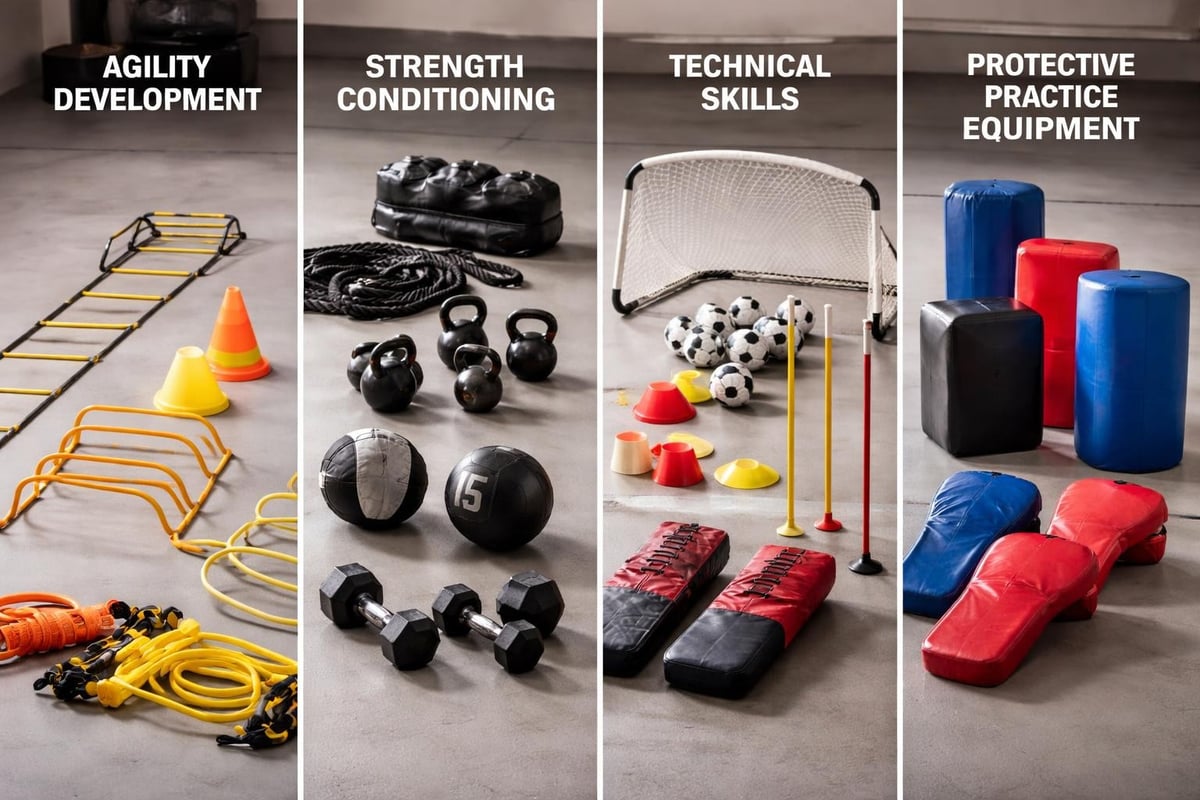
Field preparation and organization equipment completes the training environment. Portable goals, boundary markers, yard line markers, down indicators, and equipment carts ensure practices run efficiently. These items might seem secondary, but they significantly impact practice flow and time management.
| Equipment Category | Primary Purpose | Key Items | Typical Users |
|---|---|---|---|
| Agility & Speed | Movement efficiency | Ladders, cones, hurdles, parachutes | All positions |
| Strength & Power | Functional conditioning | Sleds, bands, vests, medicine balls | All positions |
| Technical Skills | Position-specific refinement | Passing nets, catching aids, kicking tees | Position groups |
| Protective Training | Safe contact practice | Dummies, sleds, pads, shields | Contact positions |
| Field Organization | Practice management | Markers, cones, carts, portable goals | Coaching staff |
Speed and Agility Development Equipment
Speed and agility training football gear transforms raw athletic ability into football-specific movement patterns. Agility ladders develop foot speed and coordination through progressive drills that enhance neuromuscular connections. These portable, affordable tools work for all age groups and skill levels, making them essential for teams operating under budget constraints.
Speed hurdles create explosive hip flexion and proper running mechanics. Available in various heights, hurdles accommodate developmental progressions from youth athletes learning fundamental movement patterns to advanced players refining sprint technique. Adjustable hurdles offer the best value, allowing single equipment pieces to serve multiple training purposes.
Resistance training tools add another dimension to speed development. Speed parachutes create overload during acceleration phases, building starting strength and stride power. Resistance bands attached to harness systems develop drive phase mechanics while allowing coaches to provide immediate technical feedback. These tools complement traditional weight room work by applying resistance in movement-specific patterns.
Cone Drills and Footwork Stations
Training cones remain among the most versatile and cost-effective training football gear options. Beyond simple boundary markers, cones create footwork stations for defensive backs, agility patterns for linebackers, and route running templates for receivers. The essential pieces of football training equipment identified by coaching professionals consistently include cone sets due to their adaptability.
High-visibility cones in multiple colors allow coaches to design complex drill progressions with clear visual cues. Disc cones sit lower to the ground for close footwork drills, while standard traffic cones mark larger patterns. Weighted cones resist tipping in outdoor conditions, maintaining drill integrity during windy practice sessions.
Strength and Power Training Tools
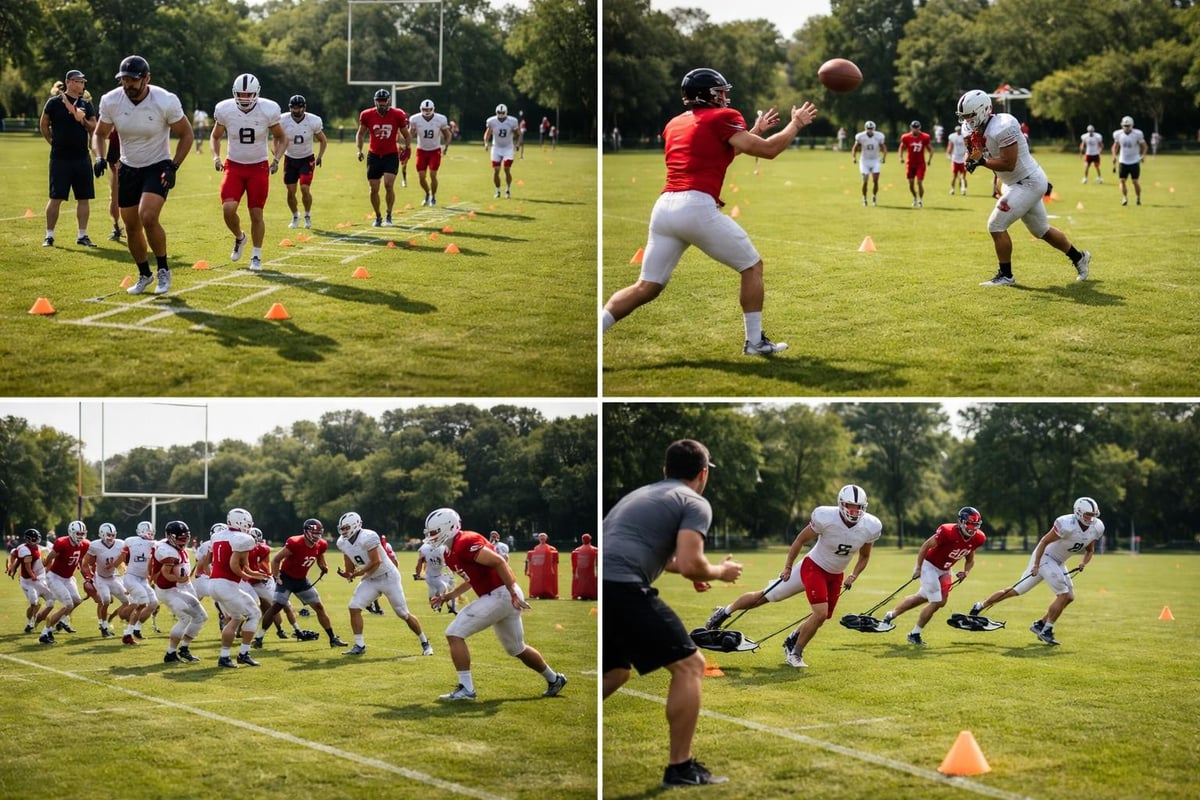
Football-specific strength development requires training football gear that mimics game movements rather than isolated muscle actions. Blocking sleds remain the gold standard for developing drive mechanics, teaching proper pad level, and building the leg drive necessary for line play. Seven-man sleds allow entire position groups to work simultaneously, maximizing practice efficiency.
Prowler sleds and weight sleds provide individualized resistance training. Athletes push or pull these implements across various distances, developing the horizontal force production essential for blocking and tackling. Unlike vertical loading in traditional squats, sled work emphasizes the forward force vectors football players actually use during competition.
- Resistance bands: Develop explosive starts and directional changes
- Medicine balls: Build rotational power and core strength through throws and slams
- Weighted vests: Add resistance to footwork drills and movement patterns
- Battle ropes: Enhance upper body endurance and grip strength
- Plyometric boxes: Develop jumping power and deceleration control
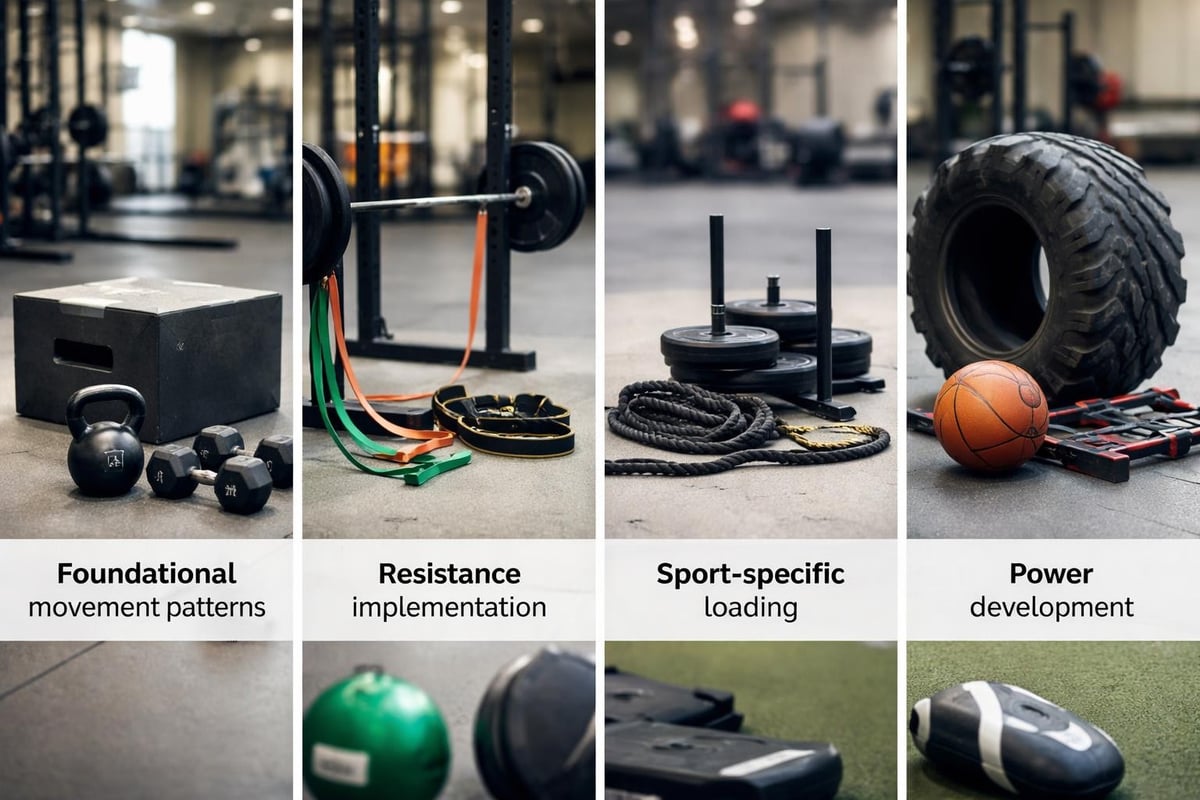
These tools integrate into comprehensive fitness and training programs that address multiple energy systems and movement patterns. The versatility of these implements allows coaches to design varied training sessions that maintain athlete engagement while targeting specific physical adaptations.
Technical Skill Development Equipment
Position-specific training football gear accelerates skill acquisition through focused repetition. Quarterback training systems include passing nets with target zones, allowing signal-callers to refine accuracy without requiring receivers. Portable target systems create competitive accuracy challenges that translate directly to game situations. According to research on football training equipment effectiveness, position-specific tools significantly reduce the time required to develop technical proficiency.
Receiver training aids range from simple catching sticks that isolate hand-eye coordination to sophisticated ball machines that deliver precise throws at various speeds and trajectories. JUGS machines and similar automated throwing systems allow receivers to accumulate high-volume repetitions efficiently, particularly valuable when quarterback availability limits practice options.
Kicking and Punting Equipment
Special teams training football gear often receives insufficient attention despite special teams' impact on field position and scoring. Quality kicking tees, holder systems, and portable field goal posts enable kickers and punters to practice independently or in small groups. Portable uprights with varying heights accommodate different age groups and skill levels while providing immediate visual feedback on trajectory and accuracy.
Punting nets capture kicks for easy ball retrieval, dramatically increasing the number of repetitions possible during dedicated special teams practice blocks. This equipment proves especially valuable for organizations where team sales and bulk purchasing make comprehensive special teams setups financially accessible.
Protective Practice Equipment
Contact sports require training football gear that allows realistic practice while managing injury risk. Blocking dummies in various shapes and weights simulate opponents for tackling technique development. Cylindrical rolling dummies teach proper pursuit angles and wrap technique. Pop-up dummies return to vertical position after contact, maintaining drill tempo without manual resetting.
Tackle wheels combine padding with rotational capability, creating dynamic tackling scenarios where athletes must adjust to moving targets. These tools develop open-field tackling skills more effectively than stationary dummies while reducing injury risk compared to live tackling drills.
| Protective Equipment | Training Application | Safety Benefit | Positions |
|---|---|---|---|
| Stand-up dummies | Blocking technique | Eliminates collision injuries | Offensive/defensive line |
| Tackle wheels | Open-field tackling | Reduces player-on-player contact | Linebackers, defensive backs |
| Seven-man sleds | Drive blocking | Controlled resistance | Offensive line |
| Hand shields | Hand fighting, shedding | Teaches hand placement safely | All positions |
| Collision pads | Contact conditioning | Progressive contact exposure | Contact positions |
The use of protective equipment in football training has been extensively studied, with research confirming that proper protective training gear reduces practice-related injuries while maintaining skill development effectiveness. This research supports investing in quality protective equipment rather than economizing on items directly related to player safety.
Selecting Training Football Gear for Different Levels
Youth football programs require training football gear that emphasizes fundamental skill development over advanced strength training. Lighter dummies, smaller cones for tighter agility patterns, and age-appropriate resistance tools prevent overtraining while building proper movement foundations. Equipment durability matters significantly at youth levels, where supervision varies and proper storage practices may be inconsistent.
High school programs benefit from comprehensive training football gear inventories that address position-specific development. At this level, athletes possess the physical maturity to safely use advanced resistance equipment while requiring technical refinement tools that accelerate skill acquisition. Budget considerations often drive purchasing decisions, making equipment versatility and multi-purpose functionality critical selection criteria.
College and competitive programs typically invest in specialized training football gear tailored to position groups and individual player development plans. These organizations often include technology-enhanced equipment like smart footballs that track throw velocity and spin rate, or timing systems that provide objective speed measurements. The best football training gear at elite levels increasingly incorporates data collection capabilities that inform training adjustments.
Essential Equipment for Complete Training Programs
A complete training football gear inventory addresses all physical and technical development areas. For organizations building programs from scratch, prioritizing equipment with broad application across positions and skill levels maximizes initial investment value. Core items include:
- Agility ladder sets (2-3 ladders for group work)
- Cone sets (minimum 50 cones in multiple colors)
- Blocking dummies (variety of sizes and shapes)
- Resistance bands (multiple resistance levels)
- Speed hurdles (adjustable heights preferred)
- Medicine balls (various weights)
- Training sled (prowler-style for multiple athletes)
- Passing nets (position-specific targets)
- Portable field markers (yard lines, boundaries)
- Equipment storage cart (organization and transport)
This foundational inventory supports comprehensive practices addressing speed, strength, agility, and technical skills. Organizations can expand from this base by adding position-specific items and advanced training tools as budgets allow.
Equipment maintenance extends useful life and protects investment value. Proper storage away from weather exposure, regular inspection for damage, and prompt repairs prevent premature replacement needs. Many suppliers, including those offering price match guarantees, provide replacement parts for quality equipment, making repair more economical than replacement.
Budget Optimization Strategies
Training football gear represents significant investment, particularly for schools and youth organizations operating under financial constraints. Strategic purchasing maximizes available funds while ensuring teams receive necessary equipment. Bulk purchasing through team sales programs often yields substantial discounts on comprehensive equipment packages.
Multi-purpose equipment delivers better value than single-function items. Adjustable hurdles serve more developmental stages than fixed-height versions. Cone sets create infinite drill variations, while specialized proprietary systems might offer limited applications. Prioritizing versatile equipment allows smaller budgets to support comprehensive training approaches.
Coordinating purchases across multiple teams or programs within athletic departments increases purchasing power. A high school ordering football equipment alongside other sport-specific items often qualifies for volume discounts unavailable to single-team purchases. This approach requires advance planning and coordination but significantly reduces per-unit costs.
Seasonal Preparation and Equipment Readiness
Pre-season equipment preparation ensures training football gear readiness when practice begins. Inventory assessment identifies items requiring replacement or repair, preventing mid-season equipment shortages. Creating detailed equipment lists by drill type streamlines practice setup and ensures coaches have necessary items readily available.
Weather considerations affect outdoor training football gear selection. Weighted cones resist wind better than standard versions. All-weather dummies maintain integrity better than foam-only versions in wet conditions. Equipment durability in various climates should inform purchasing decisions for programs in regions with challenging weather patterns.
Storage and Organization Systems
Proper equipment organization reduces practice setup time and extends equipment life. Mobile storage carts transport training football gear efficiently between storage areas and practice fields. Labeled storage sections allow quick identification and retrieval of specific items. Establishing equipment managers or rotating athlete responsibilities for setup and breakdown creates accountability while distributing workload.
Climate-controlled storage protects equipment from temperature extremes and moisture exposure. When climate control isn't available, elevating equipment off concrete floors and using breathable covers prevents moisture accumulation. These simple practices significantly extend equipment useful life, protecting organizational investments.
Integrating Technology with Traditional Training Gear
Modern training football gear increasingly incorporates technology that provides objective performance data. Smart footballs measure throw velocity, spiral tightness, and release time, giving quarterbacks quantifiable feedback on throwing mechanics. GPS tracking systems monitor player movement patterns, distances covered, and speed outputs during practices.
Timing systems provide precise measurements for agility drills and sprint work. These systems replace stopwatch timing, eliminating human reaction time variables and delivering consistent, accurate data. Performance tracking over time identifies improvement trends or areas requiring additional focus. While technology-enhanced training football gear carries higher initial costs, the data provided often justifies investment for competitive programs seeking every performance advantage.
According to high-performance football practice equipment guides, combining traditional training tools with technology-enhanced items creates optimal development environments. Technology provides objective measurements while traditional equipment facilitates the repetitions necessary for skill mastery.
Safety Standards and Equipment Quality
Training football gear quality directly impacts both safety and longevity. Equipment meeting industry safety standards prevents injuries while withstanding the repetitive stress of daily practice use. Certifications from recognized testing organizations indicate products meet established safety benchmarks.
Cheaper alternatives often compromise on materials quality, construction methods, or safety features. While initial costs appear attractive, frequent replacement needs and potential injury risks make budget options more expensive long-term. Investing in quality training football gear from reputable manufacturers protects athletes while delivering better total cost of ownership.
Inspecting equipment regularly identifies wear patterns before catastrophic failures occur. Stitching separation on dummies, cracked cones, frayed resistance bands, or damaged sled components require immediate attention. Establishing inspection protocols and removing damaged equipment from service prevents injuries and reinforces safety culture.
Maximizing Practice Efficiency Through Equipment Selection
Strategic training football gear selection maximizes practice efficiency by supporting multiple simultaneous drills. Sufficient equipment quantities allow position groups to work independently, increasing total repetitions while reducing idle time. A linebacker group running cone drills while the secondary works with tackling dummies doubles active participation compared to sequential drill structures.
Portable equipment enables quick transitions between drill stations. Equipment carts stocked with items for specific practice segments allow rapid setup and breakdown. This mobility proves particularly valuable when practice schedules require efficient use of limited field time or shared facility access.
Drill progression supported by appropriate equipment maintains athlete engagement while building skills systematically. Beginning with basic cone patterns, advancing to hurdle combinations, and culminating in resistance-loaded movements creates natural progressions that challenge athletes appropriately while preventing boredom from repetitive drills.
When evaluating comprehensive football training equipment options, considering how items integrate into complete practice plans ensures purchases support actual training methodologies rather than accumulating underutilized equipment that seemed valuable in isolation.
Selecting appropriate training football gear requires balancing developmental needs, budget realities, and quality standards while focusing on equipment that delivers measurable performance improvements. Whether you're equipping a youth program with fundamental training tools or outfitting a competitive squad with advanced development systems, Sideline Sport Supply provides the reliable, affordable equipment and straightforward pricing that helps teams focus on what matters most-player development and competitive success. Our commitment to quality products and fast fulfillment means your training equipment arrives when you need it, ready to support your program's goals.