

Sports Equipment for Basketball: Essential Gear Guide
Basketball demands precision, consistency, and the right tools to develop skills and compete effectively. Whether you're outfitting a school team, running training sessions, or managing a sports facility, selecting appropriate sports equipment for basketball directly impacts player development and game performance. From the fundamental basketball to advanced training aids, understanding what equipment serves different purposes helps coaches, athletic directors, and program managers make informed purchasing decisions that maximize their budgets while meeting their teams' needs.
Core Basketball Equipment Essentials
The foundation of any basketball program starts with quality basketballs suited to your specific environment and player level. Indoor basketballs feature leather or composite leather construction that provides superior grip and control on hardwood surfaces, while outdoor basketballs use rubber materials designed to withstand rough asphalt and concrete courts. Spalding's basketball buying guide breaks down these distinctions in detail, helping buyers understand how surface type affects ball selection.
Selecting the Right Basketballs
Different age groups and skill levels require specific ball sizes and weights. Official men's basketballs measure 29.5 inches in circumference, women's basketballs measure 28.5 inches, and youth players use smaller sizes ranging from 27.5 inches down to mini basketballs for the youngest athletes.
Key considerations when purchasing basketballs include:
- Surface compatibility: Indoor composite leather, outdoor rubber, or all-surface hybrid materials
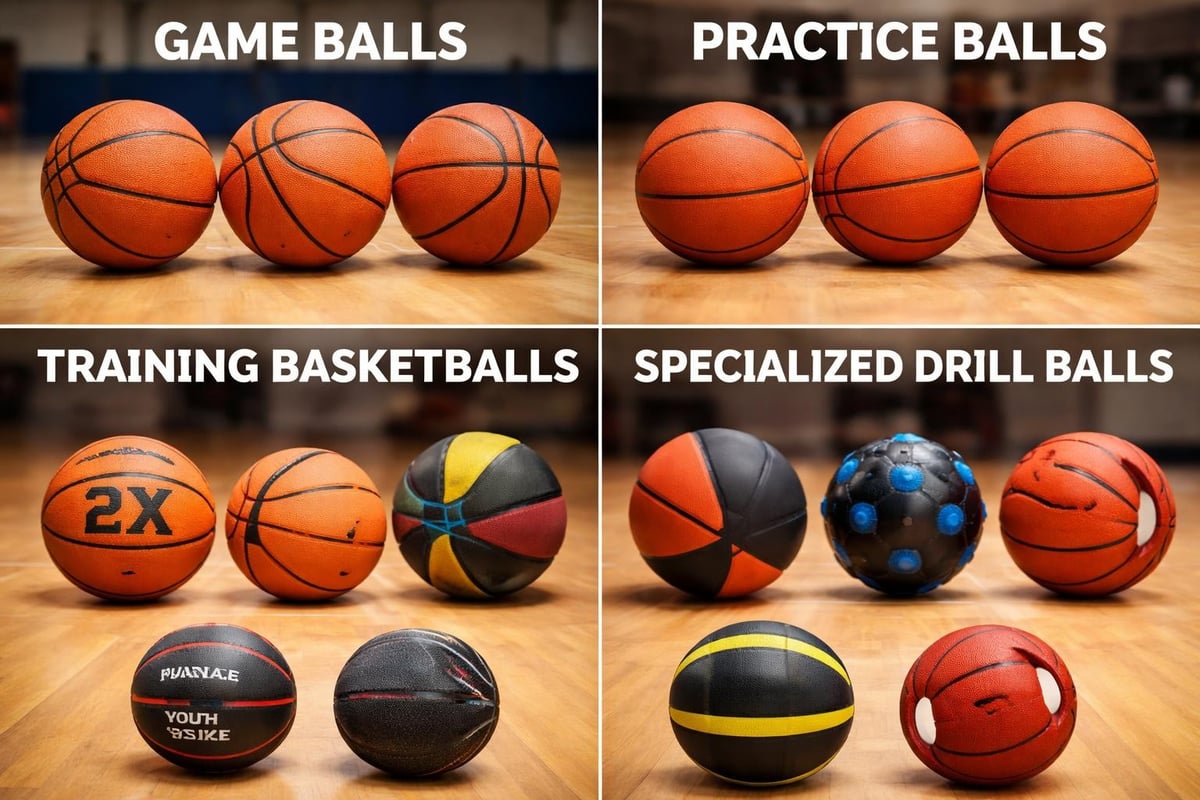
- Durability requirements: Practice balls versus game balls
- Grip technology: Channel designs and pebbling patterns
- Budget allocation: Premium game balls versus cost-effective practice balls
- Quantity needs: Adequate supply for drills requiring multiple balls
Most programs benefit from maintaining both practice-grade and game-grade basketballs. Practice balls endure heavy use during drills and scrimmages, making durability the priority. Game balls prioritize consistent performance and official specifications. The basketball equipment market continues growing as teams invest in higher-quality equipment that enhances player experience.
Basketball Hoops and Goal Systems
Goal systems represent significant investments that require careful evaluation of installation type, durability, and performance features. The three primary categories are portable systems, wall-mounted units, and in-ground installations, each serving distinct facility needs and budget constraints.
Portable Basketball Systems
Portable hoops offer flexibility for multi-purpose facilities, temporary setups, and spaces requiring equipment relocation. These systems feature weighted bases filled with water or sand, providing stability without permanent installation. Modern portable systems include height adjustment mechanisms, allowing use across different age groups and skill levels.
| Feature | Portable Systems | Wall-Mounted Systems | In-Ground Systems |
|---|---|---|---|
| Installation | No tools required | Moderate complexity | Professional required |
| Portability | High | None | None |
| Stability | Good | Excellent | Superior |
| Cost | $300-$1,500 | $400-$2,000 | $1,000-$5,000+ |
| Best For | Multi-use spaces | Indoor facilities | Permanent courts |
Quality portable basketball systems include breakaway rims that flex during dunks, protecting both players and equipment. The breakaway rim design became standard after players repeatedly damaged fixed rims and backboards during aggressive play.
Backboards and Rim Specifications
Backboard materials significantly influence rebound consistency and durability. The three common materials are:
- Acrylic backboards: Mid-range option providing good rebound response and weather resistance
- Polycarbonate backboards: Budget-friendly, durable choice for recreational use
- Tempered glass backboards: Professional-grade option delivering true rebounds and tournament-quality play
Regulation backboards measure 72 inches wide by 42 inches tall for competitive play, though smaller sizes suit recreational and youth applications. According to basketball backboard specifications, backboard thickness and mounting systems affect how the board responds to ball impact, influencing shooting practice quality.
Rim height adjustability expands equipment versatility. Systems allowing adjustment from 7.5 feet to regulation 10 feet accommodate youth development programs and progressive skill building. When evaluating sports equipment for basketball hoops, consider the adjustment mechanism's durability and ease of use, particularly for facilities serving multiple age groups.
Training and Practice Equipment
Beyond basic game equipment, specialized training tools help develop specific skills, improve conditioning, and add variety to practice sessions. These investments support player development and keep training engaging.
Ball Handling and Dribbling Tools
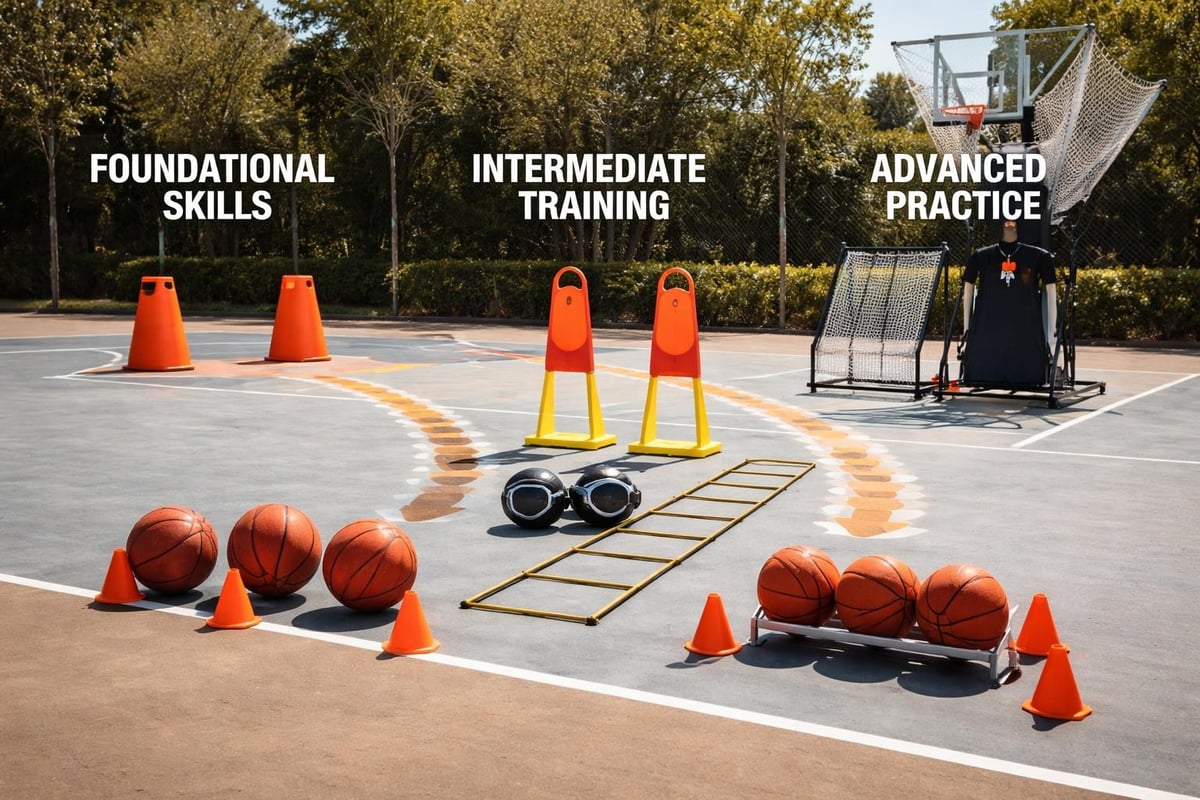
Skill development equipment includes:
- Dribble goggles: Restrict downward vision, forcing players to develop court awareness
- Weighted training basketballs: Build hand strength and ball control
- Ball handling gloves: Reduce grip, challenging players to maintain control
- Dribbling cones and markers: Create structured drill patterns
- Agility ladders: Develop footwork and coordination
These tools transform standard drills into focused skill-building sessions. Weighted basketballs, typically 3-5 pounds heavier than regulation balls, strengthen wrists and forearms while improving ball control. When players return to regulation balls, handling feels easier and more controlled.
Shooting and Scoring Development
Shooting improvement requires repetition and proper mechanics reinforcement. Equipment supporting shooting development includes:
Shooting aids attach to rims, providing immediate feedback on shot arc and entry angle. These devices help players visualize proper shooting trajectories and develop consistent mechanics. Return systems rebound made shots back to the shooter, allowing high-volume shooting practice without constant ball retrieval.
Shot trainers include devices that restrict hand placement, ensuring proper shooting form. By preventing thumb interference or palm contact, these tools build muscle memory for textbook shooting technique. Our basketball collection features equipment supporting both individual skill work and team training needs.
Rebounding machines automate ball return, dramatically increasing practice efficiency. These systems catch made and missed shots, returning basketballs to designated spots where shooters can immediately take their next attempt. This equipment proves particularly valuable for small group training and individual skill sessions.
Defensive and Footwork Equipment
Defensive skills require specific training equipment:
- Defensive slide markers: Guide lateral movement patterns
- Resistance bands: Build lateral quickness and defensive strength
- Mannequins and dummies: Simulate offensive players for defensive drills
- Blocking pads: Protect players during contact drills
- Pivot cones: Teach proper defensive positioning
Quality defensive training equipment helps players develop the lateral quickness, positioning, and strength essential for effective defense. Recent research in basketball activity recognition demonstrates how technology increasingly supports skill development, though traditional training equipment remains foundational.
Facility and Court Equipment
Complete basketball facilities require equipment beyond hoops and balls. Supporting infrastructure ensures safe, functional, and professional environments for practice and competition.
Protective Padding and Safety Equipment
Court safety equipment protects players from injury during aggressive play. Wall padding prevents collision injuries when players pursue loose balls or drive toward out-of-bounds areas. Pole padding covers basketball system supports, reducing impact severity if players contact these structures.
| Safety Equipment | Purpose | Installation Location |
|---|---|---|
| Wall padding | Collision protection | Walls behind baselines |
| Pole padding | Impact absorption | Goal system supports |
| Floor tape | Court marking | Boundary lines, drill markers |
| Scoreboards | Game management | Visible from all court areas |
Basketball nets serve both functional and safety purposes. Beyond confirming successful shots, quality nets slow the ball's descent, preventing fast-falling basketballs from striking players positioned under the basket. Chain nets offer durability for outdoor courts, while nylon nets provide the classic swish sound players associate with perfect shots.
Storage and Organization Solutions
Proper storage extends equipment life and maintains organized training environments. Ball carts hold multiple basketballs, facilitating efficient drill transitions and protecting balls from damage. Lockable storage cabinets secure valuable equipment and keep smaller items organized.
Equipment considerations for facilities include:
- Ball racks and carts: Hold 12-30 basketballs for easy transport
- Pump and needle storage: Maintain proper ball inflation
- Cone and marker organizers: Keep training equipment accessible
- First aid stations: Emergency medical supplies
- Hydration stations: Water bottles and coolers
Organizations managing multiple teams benefit from clearly labeled storage systems that allow coaches to quickly access needed equipment. The team sales approach helps schools and leagues purchase comprehensive equipment packages at volume pricing.
Game Day and Competition Equipment
Official competition requires specific equipment meeting regulatory standards. Tournament-quality sports equipment for basketball ensures fair play and professional presentation.
Scorekeeping and Timing Equipment
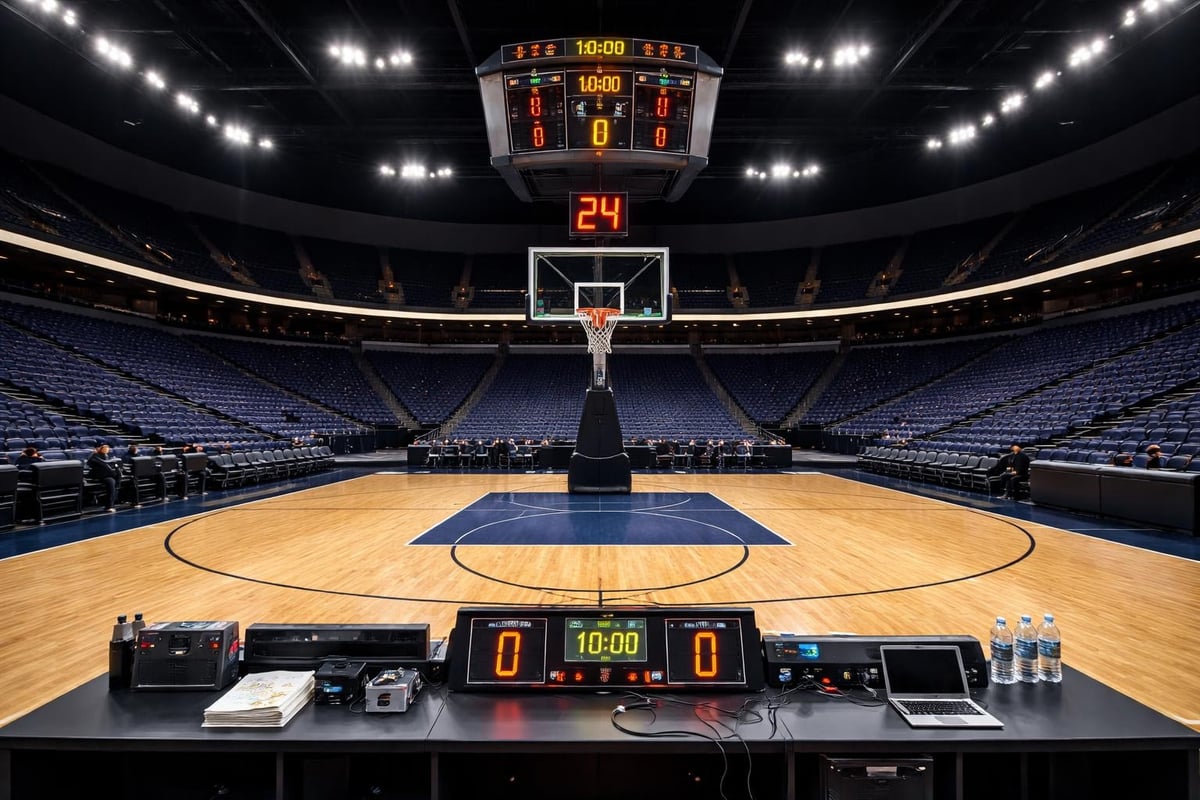
Professional scoreboards display game time, period, team scores, and possession indicators. Modern digital scoreboards include programmable features for different game formats and tournament structures. Wireless controllers allow operators to manage scoreboards from scorer's tables without cumbersome wiring.
Shot clocks have become standard even at lower competitive levels, teaching players to execute offense within time constraints. Portable shot clock systems serve facilities hosting multiple age groups with different timing rules.
Essential game management equipment includes:
- Official game balls meeting league specifications
- Scorebooks for detailed record keeping
- Possession arrows for jump ball situations
- Timing devices with audible signals
- Coaching clipboards with court diagrams
Quality scoreboards enhance spectator experience and help players track game situations. The scoreboards collection includes options for various facility sizes and budget levels.
Player Benches and Team Areas
Team benches provide organized spaces for players, coaches, and equipment during games. Portable benches allow flexibility in court configuration, while permanent installations offer stability and professional appearance. Bench lengths should accommodate entire rosters plus coaching staff, typically requiring 15-20 feet per team.
Water bottle holders, towel bars, and clipboard storage integrated into bench systems keep essential items organized and accessible. Some advanced bench systems include built-in storage compartments for first aid supplies and game equipment.
Maintenance and Longevity Considerations
Proper maintenance maximizes equipment lifespan and ensures consistent performance. Regular care prevents premature replacement and maintains safety standards.
Basketball Care and Inflation
Basketballs require consistent inflation to regulation pressure (7.5-8.5 PSI for most balls). Under-inflated balls affect bounce characteristics and shooting feel, while over-inflation stresses seams and bladders. Quality ball pumps with pressure gauges ensure proper inflation.
Cleaning basketballs extends their life and maintains grip quality. Indoor balls benefit from occasional wiping with damp cloths to remove dust and hand oils. Outdoor balls require more aggressive cleaning to remove dirt and debris that degrades rubber surfaces.
Storage conditions significantly impact ball longevity:
- Store in climate-controlled environments when possible
- Avoid extreme temperatures that affect materials
- Keep away from direct sunlight to prevent material breakdown
- Deflate slightly for long-term storage
- Rotate ball usage to distribute wear
Goal System Maintenance
Basketball hoops require periodic inspection and maintenance. Check rim integrity, ensuring breakaway mechanisms function properly. Tighten backboard mounting hardware to prevent loosening from repeated impacts. Inspect nets for tears or excessive wear, replacing them before complete failure.
Portable systems need base stability verification. Water-filled bases should be checked for leaks, while sand-filled bases may require occasional repacking to maintain stability. Pole sections on adjustable systems need lubrication to ensure smooth height changes.
The price match guarantee offered by quality suppliers helps organizations invest in durable equipment without overpaying, supporting long-term maintenance budgets.
Specialized Training Technologies
Advanced training equipment incorporates technology to provide data-driven feedback and enhance skill development. While traditional equipment remains essential, these innovations offer supplementary training benefits.
Video Analysis Systems
Portable camera systems allow coaches to record practice sessions and games for detailed review. Players benefit from seeing their mechanics, positioning, and decision-making from external perspectives. Tablet-based analysis software provides drawing tools, slow-motion playback, and comparison features.
Modern video systems integrate with mobile devices, allowing immediate review during practice breaks. This rapid feedback accelerates skill correction and reinforces proper techniques. Research on learning reusable basketball skills demonstrates how observation and feedback improve player development.
Performance Tracking Equipment
Wearable devices track player movements, jumps, and workload during practices and games. This data helps coaches manage player fatigue, prevent overtraining, and optimize practice intensity. Heart rate monitors provide cardiovascular training data, ensuring conditioning work achieves desired intensity levels.
Shot tracking systems analyze shooting percentages from different court locations, identifying areas requiring additional practice focus. These systems create heat maps showing players' most and least efficient shooting zones.
Organizations focused on fitness and training find that combining traditional equipment with modern tracking technologies provides comprehensive development programs.
Building Complete Equipment Packages
Schools, clubs, and facilities benefit from strategic purchasing approaches that address all equipment categories while respecting budget constraints. Prioritizing essential items ensures teams can practice and compete effectively before investing in specialized training equipment.
Essential Package Components
A foundational basketball equipment package includes:
- 12-15 practice basketballs
- 2-3 game basketballs
- One primary goal system
- Basic safety padding
- Ball cart or storage rack
- Pump with pressure gauge
- Whistle and scorebook
This baseline enables full team practices and competitive play. As budgets allow, programs add training equipment, backup goal systems, and technology-enhanced tools.
Budget Planning Strategies
Strategic equipment purchasing considers immediate needs versus long-term development. Quality core equipment justifies higher initial investment through extended lifespan and consistent performance. Practice equipment tolerates lower price points since replacement occurs more frequently.
Budget allocation recommendations:
| Category | Budget Percentage | Priority Level |
|---|---|---|
| Basketballs | 15-20% | Critical |
| Goal systems | 40-50% | Critical |
| Training equipment | 15-20% | High |
| Safety equipment | 10-15% | High |
| Storage/organization | 5-10% | Medium |
Volume purchasing through team sales programs provides cost savings on complete packages. Organizations outfitting multiple courts or running extensive programs benefit from package pricing that reduces per-unit costs.
Replacement Scheduling
Establishing replacement schedules prevents equipment failures that disrupt training. Basketballs typically require replacement every 1-2 years for practice balls and 2-3 years for game balls, depending on usage intensity. Goal systems last 10-15 years with proper maintenance, though components like nets and breakaway springs need more frequent replacement.
Creating equipment inventories with purchase dates helps track replacement timelines. This proactive approach prevents situations where worn equipment compromises practice quality or safety. The commitment to maintaining quality sports equipment for basketball demonstrates organizational investment in player development and success.
Selecting appropriate sports equipment for basketball requires balancing immediate needs, long-term durability, and budget realities while ensuring all essential categories receive adequate investment. Whether you're launching a new program or upgrading existing equipment, Sideline Sport Supply offers reliable, game-ready basketball equipment with straightforward pricing and fast fulfillment, helping your team spend less time sourcing gear and more time developing skills on the court.