

How to Choose the Right Sport Equipment Shop for Your Team
The right sport equipment shop for your team is one that stocks the full range of gear you buy each season, prices it transparently, backs it with real customer service, and lets you return what does not work. For coaches, athletic directors and team managers, that means judging a supplier on more than a catalog: it means checking authenticity, safety compliance, fulfillment speed and how the shop treats an order when something goes wrong.
Most equipment problems are sourcing problems. A backorder before opening day, a counterfeit item with no recourse, or a surprise shipping charge can cost a program more than a bad bid on the product itself. The sections below walk through how to evaluate a supplier, in the order most programs actually make decisions.
What Should a Team Look for in a Sport Equipment Shop?
A team should look for five things: breadth of inventory, verified authenticity, clear pricing, responsive service and a workable return policy. Each one protects your budget or your schedule in a different way.
- Breadth of inventory: A supplier that covers your sport plus the surrounding categories, such as scoreboards, benches, mats and training aids, lets you consolidate orders and reduces the number of vendors you manage.
- Authenticity: Buying from an authorized dealer means each item is genuine and carries the manufacturer's standard support.
- Straightforward pricing: Published prices and a stated price-match policy make it easier to defend purchases to a booster club or school business office.
- Service quality: Someone who can recommend the right product for your level and budget saves hours of research.
- Returns: A clear window for sending back items that do not fit your needs reduces risk on larger purchases.
Write these five criteria into a one-page scorecard before you request quotes. Scoring every supplier against the same sheet keeps the decision objective, especially when several staff members have a say.
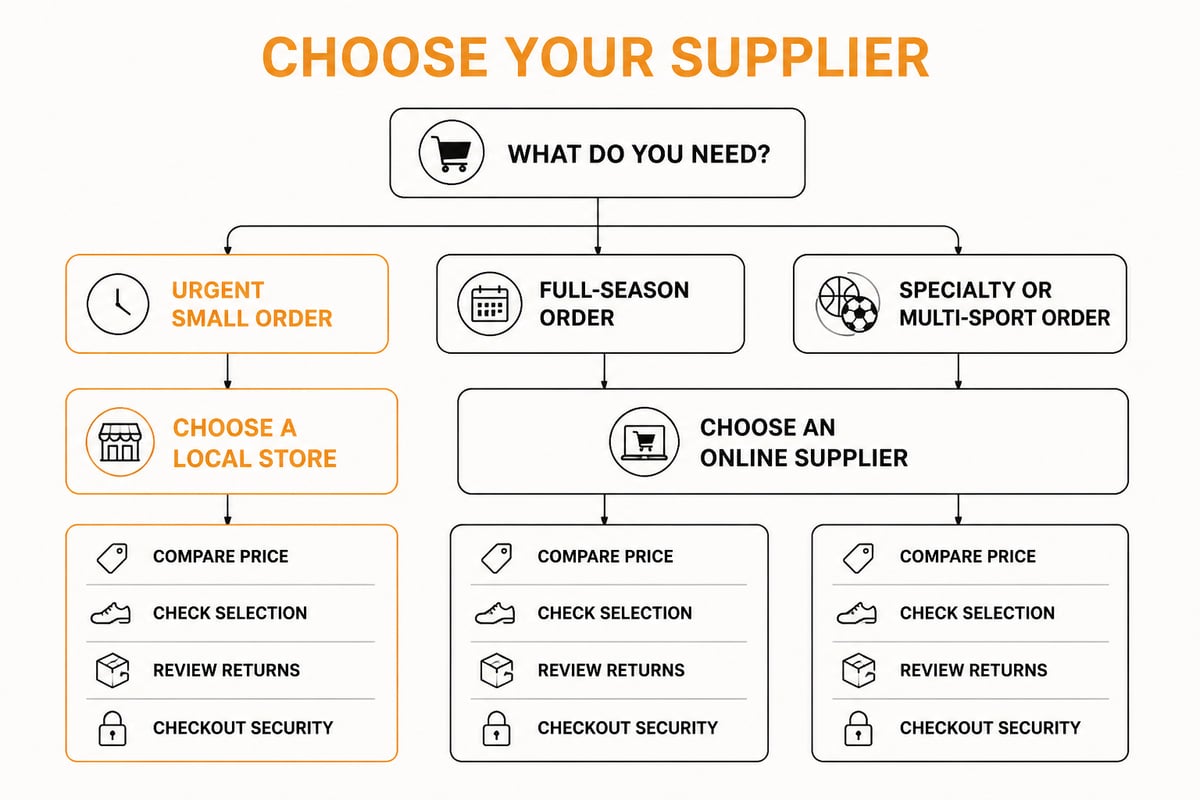
Should You Buy from a Local Store or an Online Supplier?
Local stores are best for urgent, small-quantity needs, while online suppliers are usually better for full-season orders, specialty items and price comparison. Most programs end up using both.
A neighborhood shop lets you inspect a product, try on sizing and pick up a replacement the same afternoon. The tradeoff is a narrower selection. Large, specialized items such as bleachers, batting cages, pitching machines and gymnasium structures rarely sit on a local shelf, and the stock that is there may reflect the shop's own sales history rather than your sport's needs.
An online supplier gives you the full catalog, side-by-side comparison and a paper trail for purchase orders. If you are shopping across several sports, a single catalog of team equipment is easier to audit than five separate store visits. Check how the checkout is secured before you enter payment details; Look for a supplier that states how its checkout is secured before you enter payment details.
How Do You Compare Pricing Without Chasing the Lowest Number?
Compare the total landed cost, which is the item price plus shipping, any assembly or accessory requirements, and the cost of replacing the item if it fails. The lowest sticker price often loses once those are added.
Use this short process for any purchase over a few hundred dollars:
- Request the same product from at least two suppliers, matching model numbers, not just descriptions.
- Add shipping, handling and any required hardware, such as in-ground sleeves or cover plates for gym equipment.
- Ask whether the supplier honors a price match. Ask whether the supplier offers a price match guarantee before you commit.
- Confirm the return window before you commit.
Pricing also depends on timing. Large items bought in the off-season give you more room to negotiate, check availability and schedule installation before the first practice.
How Do You Know the Gear Is Safe and Compliant?
You know gear is safe and compliant by checking it against the governing standard for your sport, not by trusting a product label alone. The standard depends on the item, so identify the rule before you buy.
Two sources show how specific these requirements can be. IFAB's 2025/26 Laws of the Game require football shinguards to be made of suitable material and an appropriate size to provide reasonable protection, and they require the guards to be covered by socks. Players are responsible for the size and suitability of their own shinguards, so your equipment checklist for soccer should include a fit reminder, not just a purchase. If you are outfitting a roster, the soccer collection is a practical starting point for goals, training tools and match accessories.
For protective and facility equipment, ASTM International's sports standards cover areas such as headgear and helmets, eye protection, athletic footwear, baseball and softball equipment, and playing surfaces. One specific example: ASTM F1936 sets a maximum of 200 g-max for impact attenuation of turf playing systems measured in the field, according to ASTM's Olympic standards overview. If a supplier cannot tell you which standard a product is built to, treat that as a warning sign.
What Equipment Does Each Sport Program Actually Need?
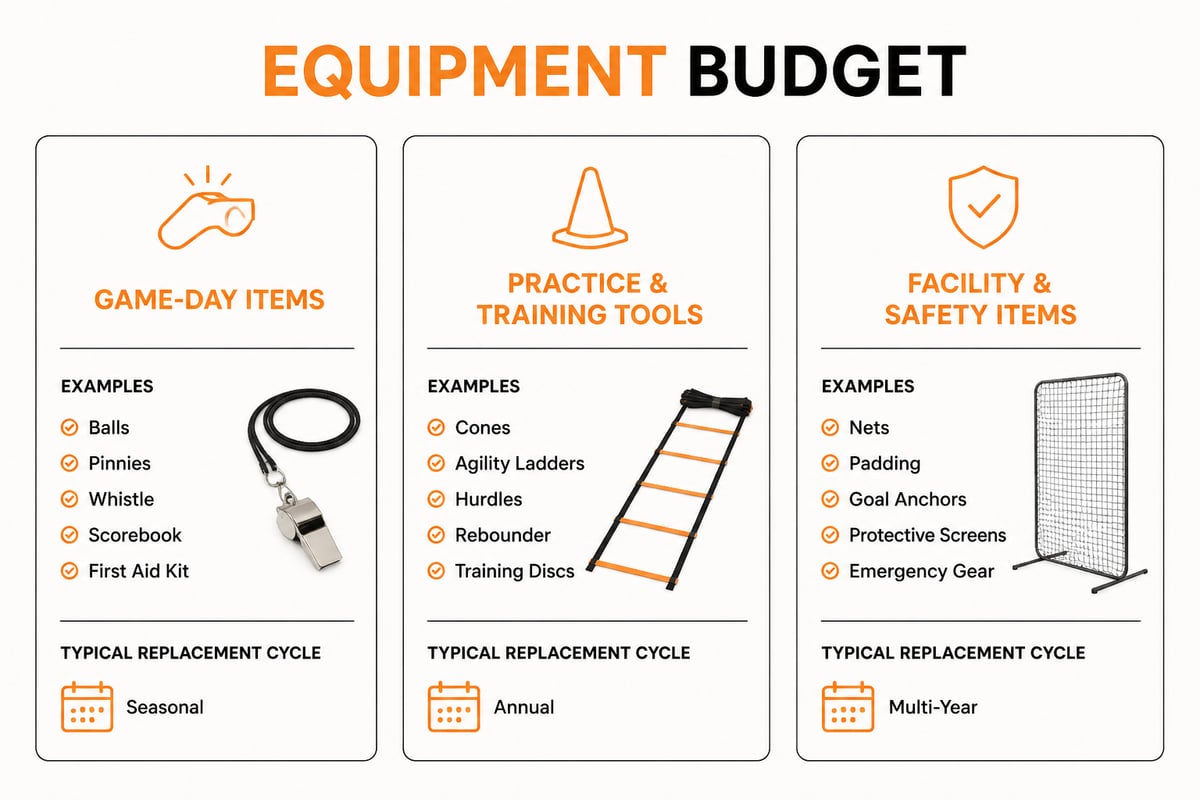
Each program needs a core set of game-day items, a set of practice and training tools, and a set of facility and safety items. Separating the three keeps budgets honest because they renew on different cycles.
| Category | Examples | Typical purchase cycle |
|---|---|---|
| Game-day | Scoreboards, bases, pitching rubbers, nets | Replace on wear or damage |
| Practice and training | Pitching machines, rebound aids, batting mats | Multi-year |
| Facility and safety | Padding, benches, bleachers, floor protection | Multi-year, inspect each season |
For baseball and softball, an 18-inch youth pitching rubber and a batter's mat are typical field-prep items. Football staffs often invest in sleds and blocking equipment such as the 7-man sled for line work. Gym-based programs should look at floor protection and standards, such as an indoor floor protector kit, which protects the surface that every indoor sport shares.
How Do You Budget for a Full Season of Gear?
Budget by starting with the roster and the schedule, then building the order from the bottom up: what every player needs, what each team needs, and what the facility needs. This prevents the common mistake of spending a large share of the budget on one visible item.
A workable sequence looks like this:
- Audit existing inventory. Count usable items, flag what is damaged, and record what failed last season.
- Rank needs by risk. Protective and safety items come first, followed by game-critical gear, then convenience items.
- Reserve a contingency. Holding back a small share of the budget covers mid-season replacements and late roster additions.
- Group orders by supplier. Consolidating reduces shipping costs and administrative time.
The SFIA's 2025 Team Sports Parents' Insights Report gathered usable responses from parents involved in youth team sports in summer 2025. The report itself notes that its self-selected sample is directional and not nationally representative, so treat it as context for how families think about participation costs rather than as a benchmark. Still, it is a reminder that families notice what equipment costs, which is one more reason to document why each purchase was made.
What Does Equipment Maintenance Have to Do with Choosing a Supplier?
Maintenance matters because the supplier you choose determines how easily you can replace worn parts, source accessories and verify what you already own. A shop that stocks consumables and replacement components saves you from replacing an entire system when one part fails.
The National Athletic Trainers' Association advises that teams ensure sports equipment is in safe working order, in its youth sports safety tips. Apply the same discipline to everything on your equipment list. Build a calendar with three layers:
- Pre-season inspection: Check padding, nets, mats, anchors and hardware.
- In-season spot checks: Walk the facility weekly and log any wear.
- Post-season review: Decide what to repair, replace or retire before storage.
Small hardware matters here too. Protective pieces such as rail protector padding and in-ground cover plates are inexpensive compared with an injury or a damaged floor, yet they are the items that tend to vanish from a budget.
How Do Return Policies and Service Affect Your Decision?
Return policies and customer service determine how much risk you carry on every order, so they should weigh as heavily as price. A generous return window means you can test a product against your actual needs before the season depends on it.
Ask these questions of any supplier before you place a large order:
- How long do I have to return an item, and which products are excluded?
- Who pays for return shipping?
- Can someone help me match equipment to my level of play and budget?
- What happens if a part arrives damaged?
A good supplier offers a clear return window on most products and knowledgeable customer service to help find the right equipment for any budget. For exceptions or specific product terms, check the relevant product page or contact the team directly so you are working from current policy.
What Is the Fastest Way to Vet a New Supplier?
The fastest way is a small trial order. Before you commit a season's budget, place a modest order for non-critical items and evaluate the whole experience, from the quote to the unboxing.
Track four things on that trial order:
- Accuracy: Did you receive the right items in the right quantities?
- Condition: Was everything undamaged and as described?
- Communication: Did you get clear updates, and did someone answer questions promptly?
- Paperwork: Were invoices and receipts usable for your business office?
A trial also reveals how a supplier handles problems. If a wrong item arrives, how quickly is it corrected? That single interaction tells you more than a marketing page. Programs that reuse the same trial-order template each year build a documented record, which helps when staff turn over and a new athletic director inherits the relationship.
How Should You Plan Around Lead Times and Installation?
Plan around lead times by working backward from your first scheduled practice or home event, then adding a buffer for shipping, assembly and inspection. Large items need the longest runway.
Items that typically require extra planning include:
- Scoreboards and wireless controls, which need power, mounting and testing; the multisport LED scoreboard is one example.
- Basketball and volleyball hardware, which depends on correct in-ground sleeves and floor fittings.
- Bleachers and benches, which may need site prep and assembly time.
- Batting cages and pitching machines, which need space, power and a safe setup plan.
Because Sideline Sport Supply does not publish a universal lead time across its catalog, confirm availability and delivery expectations for each product on its page or through its contact channels before you set a delivery date. Build that confirmation into your purchase timeline, and schedule a walk-through the week the equipment arrives so that anything damaged or incomplete can be handled inside the return window.
Which Supplier Features Matter Most for Schools Versus Clubs?
Schools usually prioritize purchase-order compatibility, durability and multi-sport coverage, while clubs and college programs often prioritize speed, flexibility and training tools. Knowing your own profile keeps you from paying for features you will not use.
A school athletic department buying for multiple teams benefits from a supplier that covers many sports at once, so a single relationship can handle football, basketball, volleyball, baseball and softball. A club with a tight season may care more about how quickly an item arrives and whether a customer service representative can recommend a training aid on short notice. Colleges often add performance tools such as radar guns and video systems, so a catalog that includes radar and performance tracking and indoor video options can serve a developing program without adding vendors.
Whatever your profile, a sport equipment shop that documents its policies clearly will be easier to work with year after year. Keep your scorecard, your trial-order results and your maintenance calendar together in one shared folder so the next person to hold your role can pick up where you left off.
Start by building a one-page supplier scorecard and running a small trial order against it this week. When you are ready to equip a roster, Sideline Sport Supply can help with authorized-dealer gear, price matching and expert service, so you can shop by sport and find the right equipment for your budget.